Super Bowl Accumulator Strategy for UK Punters
 Available in US
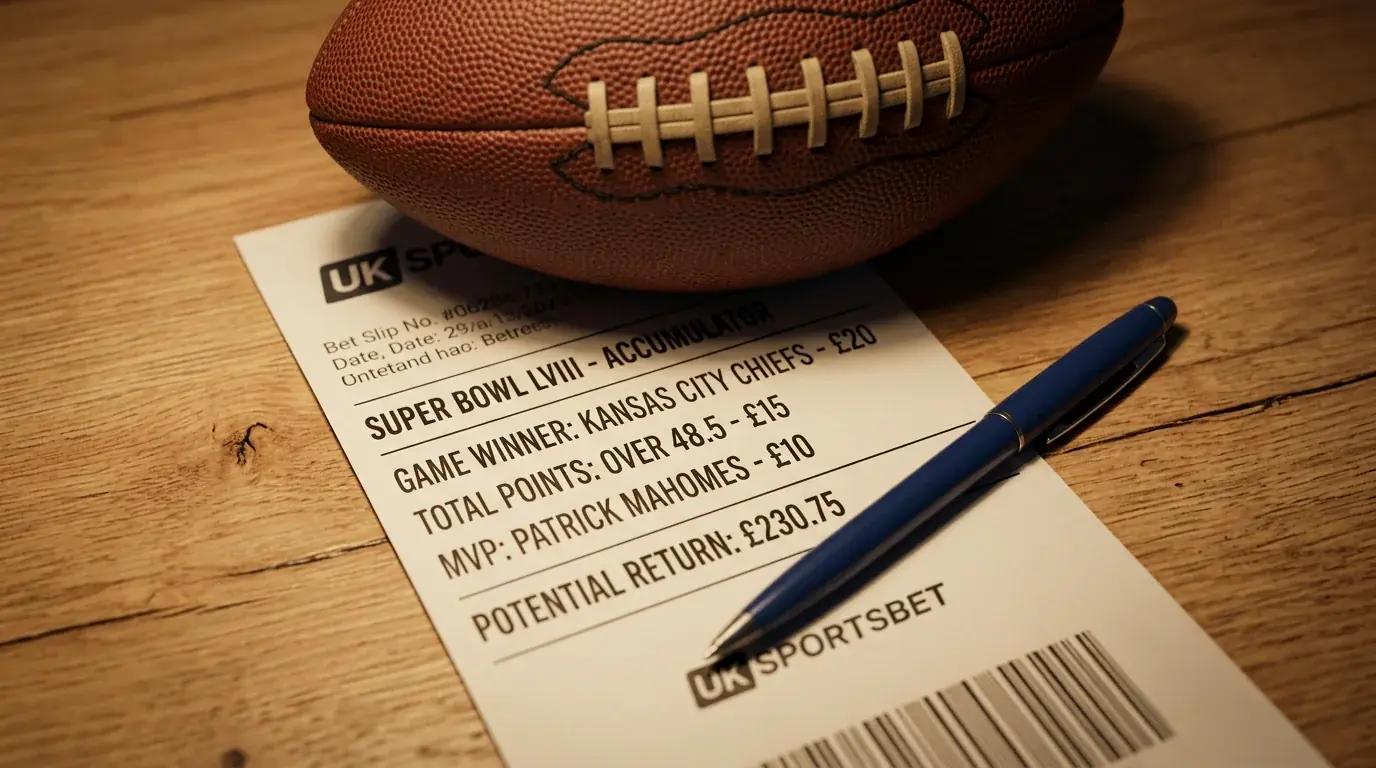
The Super Bowl is the single most-bet event in the UK NFL calendar, and the accumulator slip is the betting product that most UK fans build for it. Super Bowl LVIII drew 3.4 million unique UK viewers – up 48% year-on-year – and a meaningful share of those viewers placed at least one multi-leg bet across the game’s various markets. The structural challenge is that Super Bowl accas are priced more aggressively than regular-season equivalents, with operators recognising the surge in casual betting interest by widening the embedded margin on multi-leg products. UK punters who understand how this margin compounds, and where the structural traps sit, build accumulators that survive the actual statistical reality of a single-game four-quarter event.
The Correlation Trap That Catches Most Super Bowl Multis
The first analytical principle for Super Bowl accumulators is that legs within a single game are not independent. A team total over and an anytime touchdown scorer from that team are positively correlated. A first-team-to-score market and the same team’s moneyline are positively correlated. A game total over and both team totals over are positively correlated. UK operators understand these correlations and price same-game multis accordingly, embedding additional margin where the correlation favours the punter and pricing more aggressively where the correlation favours the bookmaker.
The trap for casual UK punters is the opposite-correlation multi – combining selections that are negatively correlated and being priced as if they were independent. A favourite moneyline and an over-points total can be negatively correlated when the favourite’s path to victory runs through ball control rather than scoring. A specific player’s anytime touchdown scorer market and the opposing team’s moneyline can be negatively correlated. Operators that price these multis as independent legs are providing structural value to punters who recognise the negative correlation. Operators that recognise the correlation in their pricing engines remove that value.
For UK punters approaching Super Bowl multis, the practical step is to build the multi mentally first and then check whether the operator’s same-game-multi product offers the combined legs at a price superior to the product of the individual standalone prices. If the same-game-multi price is shorter than the product of standalones, the operator has identified positive correlation and is charging for it. If it is longer, the operator’s pricing engine has missed the correlation and there is structural value. The latter case is rarer than the former but does occur, particularly on less-trodden combinations of player props.
The MVP-Plus-Winner Structure
The classic Super Bowl multi structure is the Super Bowl MVP-plus-Super Bowl winner combination. These two markets are tightly correlated – the MVP comes from the winning team in roughly 95% of Super Bowls, and the MVP is overwhelmingly the winning team’s quarterback in the modern era. UK operators reflect this correlation in their same-game-multi pricing, but the magnitude of the embedded margin varies meaningfully across operators.
For a multi pairing the favoured team’s moneyline at evens with that team’s quarterback as MVP at 7/4, the product of the standalone prices implies combined odds of around 9/2. Same-game multis at UK operators typically price this combination between 3/1 and 4/1, reflecting both the embedded correlation premium and the standard multi-leg margin compounding. A punter running the same selections as separate single bets at the standalone prices captures the higher implied return at the cost of needing both legs to land – which they would need anyway in the multi structure. The standalone-bet route is mathematically equivalent in outcome but typically delivers a meaningfully better return than the same-game-multi route.
The exception is when the operator’s same-game-multi pricing engine has not adjusted for a late-week shift in MVP odds, which occasionally happens when injury news or pre-game narrative shifts cause individual market prices to move faster than the multi-product engine recalculates. UK punters who place their Super Bowl MVP and moneyline bets via separate single placements rather than through the same-game-multi structure are generally extracting better value, with the additional benefit that they can deploy any cash-out flexibility on each leg independently.
Novelty Markets and the Multi Slip
UK Super Bowl betting carries a deep menu of novelty markets – coin toss, length of national anthem, halftime show prop bets, Gatorade colour, first commercial advertiser and similar. These markets generate significant casual betting interest around the Super Bowl, and many UK punters incorporate one or two novelty legs into their main multi structure.
The structural problem with novelty legs in serious multis is that they introduce uncorrelated variance without adding meaningful expected value. A coin toss leg at evens contributes 50% probability with zero analytical advantage to the punter. Including it in a four-fold reduces the probability of the multi landing by 50% in exchange for doubling the potential return – a mathematically neutral trade if the underlying odds are exactly fair, and a negative-expectation trade once the operator’s margin is included.
For UK punters who enjoy novelty markets as part of the Super Bowl experience, the rational structural approach is to keep them on a separate slip from any multi where the analytical work has been done. Novelty markets are entertainment products – Super Bowl LIX drew $1.39bn in legal US wagers from 68 million Americans, a meaningful fraction of which sits on novelty markets, and the operator economics on those markets reflect their position as casual entertainment rather than analytical opportunities. Mixing entertainment legs into analytical multis dilutes the work that went into the analytical legs without adding any compensating value.
The Bankroll Discipline for a Single-Night Event
Super Bowl accumulator betting concentrates significant stake into a single four-hour window, and the bankroll discipline required to handle that concentration is different from the discipline required for a regular-season Sunday slate. The principle that works is allocating a specific Super Bowl budget – distinct from the regular-season weekly budget – and capping total Super Bowl exposure at a defined fraction of the annual NFL bankroll. My own framework caps annual Super Bowl exposure at 10-15% of the NFL season bankroll, with no single multi exceeding 2% of bankroll regardless of how appealing the structure looks.
That cap feels restrictive on Super Bowl Sunday because the marketing intensity, the social betting culture and the once-a-year framing of the event push casual punters toward larger stakes than they would consider in any other context. The Super Bowl represents the single largest single-event handle in UK NFL betting, with under-35 viewership specifically up 91% year-on-year for Super Bowl LVIII and 74% of UK under-35 NFL viewers watching the Super Bowl. The audience is engaged. The betting volume reflects that engagement. The structural risk for individual punters is that the broader cultural intensity of the night pushes stake sizing beyond rational levels.
For UK punters approaching the 2025-26 Super Bowl with discipline, the realistic posture is to treat the single-night budget as the analytical constraint and the multi structure as the deployment mechanism. Build the multi after deciding the budget, not before. Use the budget to size each leg appropriately. And accept that the Super Bowl is one event among eighteen regular-season weeks plus four playoff rounds, not a punctuating climax that justifies abandoning the season-long staking framework.
The Pre-Game Window and Late Information
Super Bowl markets carry one structural feature that few regular-season fixtures match: a two-week build-up between conference championships and the Super Bowl itself, during which prices move continuously as injury reports, betting volume and narrative shifts work through the operator pricing engines.
For UK punters this two-week window is one of the most useful structural opportunities in the entire NFL betting calendar. Lines posted immediately after conference championship results frequently shift by 5-10% across the two-week build-up as the market digests information that was not available at the moment of opening. Punters who track the daily price movements across multiple operators can identify the days on which their preferred selections sit at their longest available prices, and stage their stakes accordingly.
The structural counter-pressure is that operators recognise this two-week window as their highest-handle period and deploy their most aggressive promotional spending into it. Sign-up offers are larger, odds boosts are deeper and existing-customer promotions are more frequent than at any other point in the season. UK punters with discipline can extract meaningful incremental value from these promotions while maintaining their core analytical positions, but the same promotional intensity creates the temptation to over-stake by treating the promotional value as a discount on irrational positions rather than as marginal value on positions that were already structurally sound.
Building the Multi That Survives the Game
For UK NFL punters approaching Super Bowl LX in February 2026, the operational framework reduces to a few principles. Place analytical bets as single placements rather than as same-game multis where possible, because the standalone pricing usually returns better value than the bundled product. Treat novelty markets as separate entertainment exposure rather than as legs in serious multis. Cap single-night Super Bowl budget at a defined fraction of the season bankroll and resist marginal-stake creep through the build-up window. And use the two-week pre-game period to stage placements at their longest available prices rather than committing the entire budget on the first day after conference championships.
For the broader accumulator framework that contextualises how Super Bowl multis fit into a season-long approach, my analysis at NFL accumulator tips covers the underlying staking discipline and selection rules that apply across the full eighteen-week regular season. The Super Bowl is the calendar’s largest single event but it is not a structurally different mathematical environment from the regular-season accas – the same compounding margin applies, the same correlation traps exist, and the same selection-quality requirements determine whether a multi delivers positive expected value or simply pays the operator’s compounded margin.
Super Bowl LX will draw the biggest UK NFL betting handle of the 2025-26 season. It will also be the single event where casual punters are most likely to abandon the staking discipline that protected them through the regular season. For UK punters who maintain that discipline through Super Bowl Sunday – placing analytically grounded stakes at appropriate sizes within a defined event budget – the Super Bowl is a coherent capstone to the betting year. For those who do not, it is a structural drain that erases months of careful regular-season work in a single overnight session. Which version arrives in February depends on decisions made before the game starts, not during it.
Are same-game multis priced more harshly for the Super Bowl than for regular-season fixtures?
In percentage-margin terms, yes. UK operators consistently embed wider margins into Super Bowl same-game multis than into equivalent regular-season same-game multis, reflecting the larger volume of casual betting handle on the marquee fixture and the operators’ assessment that price sensitivity among casual Super Bowl bettors is meaningfully lower than among regular-season bettors. The practical consequence is that placing the same selections as separate single bets typically returns 10-20% more than the same-game-multi product on the major UK platforms during Super Bowl week. UK punters who default to same-game multis for Super Bowl betting are paying an additional convenience premium that does not exist in the same magnitude during the regular season, and recognising this is one of the cleaner structural improvements available to UK Super Bowl bettors.
Can novelty markets be combined with main game markets on the same Super Bowl multi slip?
The major UK-licensed operators allow novelty markets to be combined with main-game markets on standard accumulator slips, with the legs treated as independent for pricing purposes. The structural caveat is that novelty markets typically settle on outcomes resolved before kick-off – coin toss, length of national anthem and similar – which means the multi’s combined probability calculation includes a leg that has zero analytical relationship to the underlying NFL game. For UK punters this means a multi mixing novelty legs and game legs is effectively a slot-machine combination of an analytical bet and a coin-flip bet, with the headline odds reflecting both. The mathematical case for separating novelty markets onto a dedicated slip is strong, even though the operator products generally allow the combination.
Published by the nfl Betting Markets team.