Betting on NFL Games in London and Dublin: Venue-Specific Edge for UK Punters
 Available in US
- Why home-soil NFL changes the betting question
- The International Series footprint, 2007 to today
- Wembley vs Tottenham Hotspur Stadium: surface, capacity, atmosphere
- Croke Park 2025: betting on a maiden Irish NFL fixture
- The “designated home team” angle UK lines often misprice
- The 14:30 UK slot and its effect on totals and pace
- UK weather, October pitches and the under/over question
- If you’re at the stadium: in-app betting and connectivity
- Reading the 2025 schedule through a betting lens
- UK fan-and-punter questions on London and Dublin games

Why home-soil NFL changes the betting question
The first NFL match I bet on in person was at Wembley in 2018. I had spent the previous decade betting on American football from a flat in north London at three in the morning, drinking lukewarm coffee and squinting at decimal odds. Walking into Wembley with a betting slip on my phone and 86,000 people around me felt like watching one type of betting collapse into another. The fixture was the same. The pricing was different. The decisions you make at home and the decisions you make at the stadium turned out to be different decisions entirely.
That is the question this guide is built around. Why does home-soil NFL — meaning matches played in London or Dublin, in front of UK and Irish crowds, in UK time zones — change the betting calculus? And how can punters read the markets that wrap around these fixtures with more sophistication than the average UK book is pricing for?
The numbers tell you why this matters. More than 3 million fans have attended NFL matches in London since 2007, generating an estimated 2 billion pounds of economic impact. By the end of the 2025 season, more than 40 regular-season NFL matches had been played in the British capital. The 2025 international slate added something new: the first ever NFL fixture in Ireland, Steelers against Vikings at Croke Park on 28 September. And Tottenham Hotspur Stadium, which is the only stadium outside the United States that has been purpose-built to accommodate NFL matches, hosted two of the three London fixtures.
What that footprint produces, from a betting perspective, is a small but persistent inefficiency. UK books price London and Dublin games using the same models they apply to US-based fixtures, then add a layer of “neutral venue” adjustment that does not always reflect the actual conditions on the day. The crowds are different. The weather is different. The travel burdens cut differently for the two participants. The kickoff times reshape the broadcast pacing in ways that affect scoring distributions. None of this is secret. All of it is in the public domain. But the markets sometimes lag, and that lag is where venue-specific UK edge tends to live.
This article is for the punter who wants to read those games as different bets, not as standard fixtures with a Wembley postcode. We will cover the International Series history, the two London venues and Croke Park in 2025, the designated home team angle, the kickoff slot, the weather and surface considerations, and what to do if you happen to be at the stadium yourself. By the end you should be able to look at a London or Dublin fixture and know which assumptions in the standard pricing models do not quite hold.
The International Series footprint, 2007 to today
Friends often ask when the NFL “really arrived” in the UK. The honest answer is that it arrived in 1983, when the Vikings played the Cardinals at Wembley as a one-off exhibition. The real continuity dates from 2007, when the league started playing regular-season fixtures in London on an annual basis. Everything before that was a curiosity. Everything since has been infrastructure.
The International Series footprint expanded steadily through the 2010s and accelerated through the 2020s. The 2025 international slate carried six regular-season matches outside the United States, a record, with three of those in London — Vikings against Browns at Tottenham on 5 October, Jets against Broncos at Tottenham on 12 October, and Jaguars against Rams at Wembley on 19 October. Add the Madrid fixture at the Bernabéu and the Croke Park debut, and you have an international schedule that takes American football to crowds that would have been considered fantastical when I started covering this market.
The single most striking attendance number in the London era was the Jaguars-Patriots fixture in October 2024, which drew 86,651 fans to Wembley — a record for an NFL match at the venue. NFL UK General Manager Henry Hodgson framed the 2025 slate as a continuation of that trend, noting in August that the season would push the capital past 40 regular-season London games and emphasising the role the UK has played in growing the game globally.
What that history tells you, from a betting perspective, is that the UK NFL market has crossed a threshold from novelty to established product. UK trading desks now have more than fifteen years of London-fixture data to model from. They know how visiting teams perform after a transatlantic flight. They know how London crowds affect home-team designations. They know how the 2:30 PM kickoff slot shifts scoring patterns. Most of that knowledge is now baked into the standard pricing for London games, which means the gap between London prices and equivalent US-fixture prices is narrower than it used to be.
But narrower is not zero. The lag I described in the introduction shows up most clearly in three places: in the first half of the season, when UK trading desks have not fully recalibrated to current rosters; in fixtures involving teams that have not played in London before, where the UK-specific data is thin; and in fixtures where the matchup involves a road-trip narrative that the broader market has not absorbed. Croke Park 2025 was an example of the third category — the bookmakers had no Dublin-fixture data at all, and the lines reflected that uncertainty in subtle but readable ways.
Wembley vs Tottenham Hotspur Stadium: surface, capacity, atmosphere
I have been to both Wembley and Tottenham for NFL matches, and the difference is greater than the postcodes suggest. They are different stadiums, with different surfaces, different crowd dynamics, and different effects on betting markets if you read them carefully.
Wembley is the older venue in NFL terms, having hosted regular-season fixtures since 2007. Capacity for NFL matches sits around 84,000 to 86,000 depending on configuration, with the 2024 Jaguars-Patriots fixture setting the venue record at 86,651. The pitch is grass, which is repaired between fixtures but takes a beating during the October NFL slate when it is also being used for football and rugby. The stadium itself is built for a different sport, and the broadcast angles, lighting and acoustics reflect that.
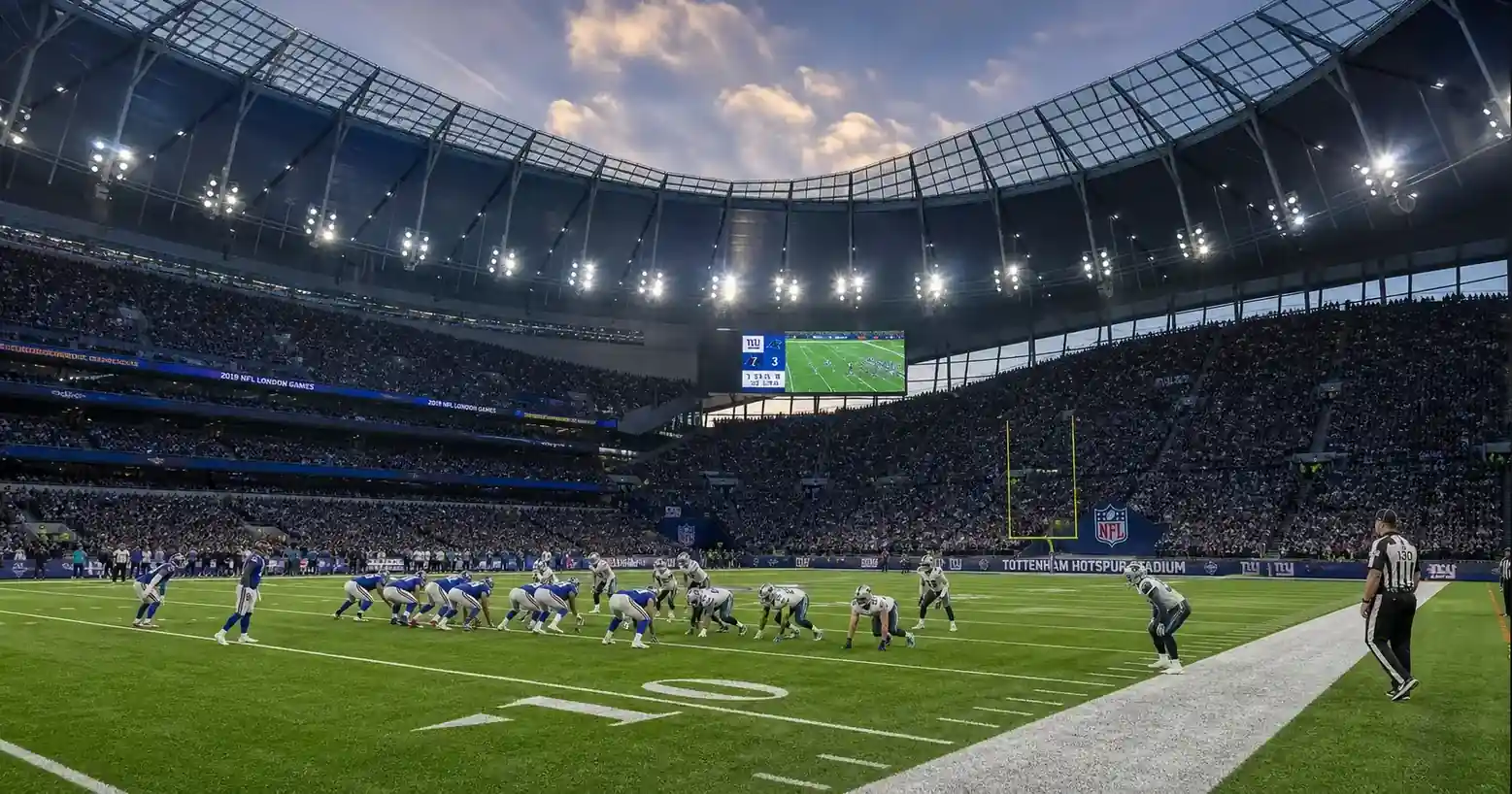
Tottenham Hotspur Stadium is, in NFL terms, a different beast entirely. It is the only stadium outside the United States that has been purpose-built to accommodate NFL matches. The grass football pitch slides apart in three sections, revealing a permanent NFL-grade artificial surface underneath. That mechanism is the most interesting thing in European stadium architecture for a generation, and it has direct betting implications.
The first implication is surface. Wembley is grass; Tottenham, for NFL matches, is artificial. NFL teams have measurable performance differences between grass and turf, particularly in passing efficiency and injury rates. UK books typically do not price these distinctions explicitly, treating both venues as roughly neutral for betting purposes. That treatment is a small but consistent inefficiency, particularly in totals markets, where grass venues tend to play marginally lower-scoring than equivalent artificial-surface fixtures.
The second implication is capacity and atmosphere. Wembley holds about 86,000. Tottenham holds about 62,000 for NFL configuration. The smaller, more vertical Tottenham bowl produces noticeably more concentrated crowd noise on third downs, which has real effects on visiting offences. Anecdotally, false-start penalties tend to rise when visiting offences face the Tottenham crowd late in close games. UK books do not typically adjust for this. The effect is small but real.
The third implication is scheduling. Tottenham hosts back-to-back London games in early October most years; Wembley typically hosts a single fixture later in the month. That scheduling pattern means Tottenham fixtures tend to feature teams a week earlier in the international travel cycle, while Wembley fixtures involve teams whose recovery from transatlantic travel has been studied more thoroughly. Sky Sports’ chief sports officer Jonathan Licht described the league’s UK growth as captivating audiences first-hand around the time of the 2025 schedule announcement, and that growth has come predominantly through the Tottenham gateway.
For a deeper look at how Tottenham fixtures have priced over recent seasons and what the venue-specific patterns have been, I have written about betting on NFL fixtures at Tottenham Hotspur Stadium in standalone form. For the purposes of this comparative piece, the takeaway is that Wembley and Tottenham should be priced as different venues, even when the matchup is otherwise identical. UK books are getting better at this, but the lag is real.
Croke Park 2025: betting on a maiden Irish NFL fixture
The Steelers-Vikings fixture at Croke Park on 28 September 2025 was the first regular-season NFL match ever played in Ireland. I watched it from the upper tier of the Cusack Stand, in a venue that has hosted Gaelic football and hurling for over a century, with FanDuel — Flutter’s flagship brand — running advertising as the exclusive betting sponsor of the fixture. The combination was unusual. The pricing of the match itself was instructive.
UK and Irish books treated Croke Park as a true neutral venue for the Steelers-Vikings fixture, which was technically correct but operationally a bit strange. The venue had no NFL history, the crowd dynamics were unknown, and the surface was Croke Park’s traditional grass — which is exceptional grass by sporting standards but not NFL-spec by any measure. The bookmakers priced the match using their standard neutral-venue model, with a small adjustment for the international-travel burden on both teams.
What that produced was a market with slightly wider hold than equivalent London fixtures. The bookmaker uncertainty manifested as a touch more juice on each side of the spread and a touch more on each side of the totals line. For UK punters who were paying attention, the implication was clear: line shopping mattered more than usual on the Croke Park fixture, because the price gaps between books were wider than on a Wembley game.
The other interesting feature of the Croke Park market was the novelty surrounding it. UK and Irish books offered “first scoring play” markets, “first team to 10 points” markets, and a range of Irish-specific novelty offerings tied to the venue and the broadcast pacing. These were entertainment products with predictably high holds, but the volume on them was meaningful — the fixture had genuine cultural cachet in Ireland, and the betting handle reflected that.
The medium-term question, which I do not pretend to have an answer to, is whether Croke Park becomes a recurring NFL fixture. The 2025 match was framed as a one-off, but the attendance and the broadcast reach were both strong enough that another Dublin fixture in 2026 or 2027 is plausible. If the league does return to Dublin, the betting markets will price the second fixture more sharply than the first, because the trading desks will have actual Dublin-fixture data to work from. Punters who want venue-specific edge on Croke Park fixtures should expect that edge to narrow rapidly if the league makes Dublin a regular stop.
The “designated home team” angle UK lines often misprice
Here is a quirk of NFL international fixtures that confuses British punters and that bookmakers occasionally misprice. Every London or Dublin game has a “designated home team” — the franchise that gives up a regular-season home game to play abroad. That designation matters legally, broadcast-wise, and for league record-keeping. It does not necessarily reflect anything about the betting matchup.
The Jaguars are the most extreme example. Jacksonville has played a designated home game in London almost every season since 2013. By the time you get to the 2025 fixture against the Rams at Wembley, Jacksonville had played more home games in London than several NFL franchises had played in their own actual home cities over the same span. The bookmakers know this. The recreational money does not always.
What the recreational money does is treat “home team” as a meaningful variable, applying the same 2-to-3-point home-field advantage that applies in conventional NFL pricing. That assumption breaks down at London fixtures, because neither team is at home in any meaningful sense. The crowd is a UK NFL crowd, which tends to be politely supportive of both teams rather than aggressively partisan toward one. The travel burden affects both teams to some degree, although asymmetrically — the team flying further or with the shorter prep window carries more of the burden.
Where the misprice tends to live is in fixtures where the designated home team is a strong franchise that the public assumes will benefit from “home” advantage. The pricing reflects a small home-field adjustment that is, in my reading, structurally unjustified for London fixtures. The opposing side often offers a touch of value at the spread, particularly if the underdog has the shorter international travel cycle.
The reverse case is also worth knowing. When the designated home team is a weak franchise — and historically Jacksonville has fitted that description more often than not — the public sometimes overcorrects, fading the home team beyond what the underlying matchup justifies. UK trading desks have got better at catching this in recent years, but the residual effect on totals lines is occasionally readable. Fixtures with a weak designated home team and a strong “visiting” team tend to see slightly higher totals than equivalent US-based matchups, because the bookmaker is pricing in the public’s expectation of a one-sided scoreline rather than the actual scoring distribution.
The practical UK-punter rule on home-team designation: ignore it for spread purposes unless you have specific evidence of a crowd or travel asymmetry that affects the matchup. The designation is a league-administrative artefact, not a betting variable in itself.
The 14:30 UK slot and its effect on totals and pace
The 14:30 UK kickoff is one of the unsung structural features of London fixtures, and it does more to scoring distributions than most punters realise. Standard US Sunday afternoon kickoffs are at 1pm Eastern, which means UK viewers watch them at 6pm. Sunday night fixtures kick off at 8:20pm Eastern, which is 1:20am UK time. London fixtures, by contrast, kick off at 14:30 local time, which puts them in the middle of the afternoon for both UK viewers and the visiting US team.
Why does that matter for betting markets? Three reasons. The first is body-clock disruption. A US team playing a 14:30 UK kickoff is playing the equivalent of a 9:30am Eastern Time match. NFL teams almost never play that early. Player performance data on early kickoffs shows measurably lower offensive efficiency, particularly on passing plays in the first quarter. UK books incorporate this into their first-quarter and first-half totals, but the magnitude of the adjustment is sometimes too small.
The second is broadcast pacing. NFL broadcasts in the US are paced for evening slots, with longer commercial breaks and slower drive cadences. The UK 14:30 broadcast follows roughly the same pacing template, but the in-stadium experience is faster, because the crowd is unfamiliar with the long American commercial conventions and tends to push for action between plays. That pace differential occasionally reads through into actual play tempo, particularly in fixtures where one team is comfortable playing faster.
The third, and this is the one I find most interesting, is finishing. London fixtures finish around 17:30 to 18:00 UK time, which is teatime in the UK and lunchtime in the US. UK in-play markets tend to be heavily traded throughout, but the closing-quarter dynamics are sometimes different — punters who have been watching since the morning sometimes fade as the match enters its final phase, while in the US the same fixture is being watched fresh by viewers tuning in for an early Sunday afternoon. That asymmetry can produce small inefficiencies in fourth-quarter live markets, particularly on totals.
The practical implication for UK punters: London totals lines are often a touch low relative to what the pace data suggests, because the bookmakers are weighting body-clock disruption heavily on first-half scoring. Second-half overs occasionally offer slightly better value than first-half overs on London fixtures, because the body-clock effect tends to flatten as the match progresses and US teams adjust.
UK weather, October pitches and the under/over question
The October NFL slate in London coincides with the most variable weather window in the British calendar. I have seen London fixtures played in 22-degree autumn sunshine, in horizontal rain, in low cloud with visible fog at field level, and once memorably in a thunderstorm that delayed kickoff by twenty minutes. The bookmakers know this. The way they price for it is interesting.
UK books treat London fixture weather as a known variable rather than a forecast variable, which is a subtle distinction with real betting implications. Weather data for the four hours either side of kickoff is typically published 48 hours in advance, and the book’s risk team builds the forecast into the totals line by Wednesday. By the time the fixture kicks off, the line has already absorbed expected wind, expected rainfall, and expected pitch conditions. What the line cannot absorb is the residual variance — actual conditions on the day differing from the Wednesday forecast.
That residual variance is where in-play totals markets get interesting on weather-affected London fixtures. If the forecast was for light rain and the actual conditions are heavy rain with sustained wind, the totals line will adjust live as the kickoff approaches and through the early drives. UK punters who have been watching the actual conditions develop sometimes have a small but readable edge on the in-play under, particularly in the first quarter when the players are still adapting.
The pitch question is separate from weather and just as important. Wembley grass in October has typically hosted between four and six fixtures since the season began, including football and rugby fixtures alongside the NFL slate. By the time the NFL match arrives, the surface is in noticeably worse condition than a US-based grass venue early in the NFL season. That degradation affects passing-game efficiency more than rushing efficiency, and it produces a slight under-bias in totals markets that the books do not always price fully.
Tottenham, with its purpose-built artificial NFL surface, is unaffected by the autumn pitch issue. The artificial surface plays consistently throughout the international slate. That consistency is itself a betting consideration: Tottenham fixtures are more predictable in scoring distributions than Wembley fixtures, which means the books can price them more confidently and the residual edge for weather-savvy punters is correspondingly smaller.
The simple rule I have arrived at over seven seasons: if a London fixture is at Wembley in mid-to-late October and the forecast is for sustained rain, lean toward unders both in pre-game and in early in-play markets. If the fixture is at Tottenham, the weather-edge case is much weaker, because the artificial surface drains and plays consistently regardless of conditions.
If you’re at the stadium: in-app betting and connectivity
If you are reading this from a stadium seat at Wembley or Tottenham — and a meaningful portion of UK NFL punters are at the matches in person — the betting calculus shifts in ways worth thinking about before you place anything live.
Stadium connectivity is the first variable. Tottenham Hotspur Stadium has very strong dedicated stadium Wi-Fi designed for high-density events. Wembley’s connectivity has improved markedly over recent NFL seasons but still degrades during peak in-play moments, which is exactly when you want it. Croke Park 2025 ran on a different infrastructure entirely, and reports from the fixture suggested patchy data performance during the first half before improving in the second.
The practical implication: live bets placed from inside the stadium are subject to latency and connectivity delays that home punters do not face. By the time you have seen a play happen, opened your sportsbook app, navigated to the live market, and placed the bet, the line has often moved or the market has briefly suspended. That gap is small but real, and it makes pre-game or planned in-play bets more effective than reactive in-play bets when you are at the venue.
The second variable is observational edge. Being at the stadium gives you direct sightlines on injury concerns, momentum shifts, and crowd reactions that broadcast viewers see filtered through the camera feed. That sounds like an advantage, and occasionally it is — particularly on injury observations in the moments before the broadcast catches up. Most of the time, the broadcast is more informative than the stadium view, because the broadcast layers replay angles and statistical context that you cannot see from your seat.
The third variable is decision-making environment. Stadium betting decisions are made in a high-energy, alcohol-adjacent, time-pressured environment. That is exactly the environment in which UK punters tend to make worse decisions than they would at home. The Gambling Commission requires UK-licensed operators to make deposit-limit prompts and reality-check tools available, and these are particularly worth using when betting from a stadium environment. My standard practice when I attend a London fixture is to set a hard pre-match cap on stadium-bet stakes and refuse to revisit it in-play.
Reading the 2025 schedule through a betting lens
The 2025 international slate gave UK punters a useful test bed for the venue-specific patterns I have described. Three London fixtures — Vikings against Browns at Tottenham on 5 October, Jets against Broncos at Tottenham on 12 October, Jaguars against Rams at Wembley on 19 October — plus the Croke Park debut a week before the London window opened, plus the Madrid fixture at the Bernabéu later in the season. By the end of the international block, more than 6 million UK viewers had watched London games on TV or online, with Tottenham selling out and Wembley drawing close to its 85,000 capacity.
What did the betting markets do with this slate? In aggregate, the lines were sharper than the equivalent slate two or three seasons ago. The first-quarter totals on the Tottenham fixtures absorbed the body-clock disruption pricing I described in the kickoff section. The Wembley fixture absorbed the weather and surface considerations. The Croke Park fixture, as the unprecedented data point, carried slightly wider holds and offered the most line-shopping value of the slate.
The Vikings-Browns Tottenham opener priced as a pick-em moving slightly toward the Vikings as the public absorbed the matchup. The Jets-Broncos fixture a week later priced more conventionally with a small Broncos favour. The Jaguars-Rams Wembley fixture priced the Rams as moderate favourites, with the Jaguars carrying their unusual “designated home team in London” status that the bookmakers had long since stopped treating as a betting variable.
Henry Hodgson welcomed the Jets, Browns and Jaguars to London ahead of the 2025 slate, framing it as a reflection of the UK’s role in growing the game globally. Whatever your view of NFL international expansion, the betting consequence is straightforward: the more fixtures the league plays in London, the more data the trading desks have, and the narrower the venue-specific edge for British punters becomes.
For 2026 and beyond, the pattern is likely to be: line shopping matters most on the first London fixture each season, when the trading desks are reapplying their venue model after the off-season; matters less on subsequent London fixtures as the data ages cleanly; and matters most of all on any new venue, whether that is a return to Croke Park, a new stadium in Madrid, or whatever destination the league adds next. The principle is constant. The specific application changes year to year.
UK fan-and-punter questions on London and Dublin games
Are NFL London Games priced as neutral-venue fixtures by UK bookmakers?
Mostly yes, but with adjustments. UK bookmakers treat London fixtures as effectively neutral for spread purposes, with neither team receiving the standard 2-to-3-point home-field advantage applied to US fixtures. The designated home team carries no betting weight in itself. Where bookmakers do adjust is on totals lines, where body-clock disruption from the 14:30 UK kickoff and venue-specific surface conditions get priced in. Recreational money sometimes ignores these adjustments and treats the designated home team as if it were playing at home, which is occasionally where venue-specific value sits.
Do UK sportsbooks offer special markets for the Dublin NFL game?
The Croke Park fixture in 2025 attracted dedicated Irish-themed novelty markets at major UK and Irish operators, including ‘first scoring play’ specials and Croke Park-specific in-play offerings. These were entertainment products with higher holds than standard NFL markets. Whether similar specials return for any future Dublin fixtures depends on whether the league makes Croke Park a recurring venue. The standard markets — moneyline, spread, totals, props — were available throughout, with slightly wider holds reflecting the bookmakers’ uncertainty about a venue without prior NFL data.
Does kickoff time at London Games affect totals lines?
Yes, and meaningfully. The 14:30 UK kickoff equates to roughly 9:30am US Eastern Time, which is unusually early for NFL teams. Body-clock disruption affects offensive efficiency in the first quarter and first half, and UK bookmakers price this into first-half and first-quarter totals lines. Full-game totals tend to absorb the effect by the second half, when teams have adjusted. Punters who study the body-clock and surface variables sometimes find slight value in second-half overs and first-half unders, particularly at Wembley fixtures where surface degradation compounds the timing effect.
Prepared by the nfl Betting Markets editorial staff.