Super Bowl Betting in the UK: Markets, Timing and Strategy
 Available in US
- Why the Super Bowl is the UK punter’s anchor event
- The Super Bowl audience that’s reshaping UK betting demand
- Super Bowl outright winner: how the line moves through the season
- Super Bowl MVP: positional bias and where value sits
- Match-night markets: spread, totals and quarter betting
- Novelty markets: anthem, coin toss, halftime show
- In-play during a Super Bowl that runs past UK midnight
- Building a Super Bowl accumulator without lazy correlations
- UK tax position and Super Bowl-specific promotions
- UK punter questions on Super Bowl betting

Why the Super Bowl is the UK punter’s anchor event
I have spent every Super Bowl Sunday for the past seven years awake at three in the morning, watching a sport that most of my non-betting friends still describe as “that American thing where they keep stopping”. I have seen the UK NFL audience triple over that span. I have watched bookmaker behaviour change in lockstep, from grudging Super Bowl coverage as a Sunday-night afterthought to dedicated trading desks running novelty lines on the colour of the sports drink that gets poured over the winning coach.
The Super Bowl has become the UK punter’s anchor event for one straightforward reason: there is nothing else like it on the calendar. The FA Cup final has more domestic resonance, the Champions League final has more European weight, but neither carries the volume of distinct betting markets the Super Bowl generates in a single match. A Sunday-evening Premier League fixture might offer 200 markets at a major UK book. A Super Bowl carries between 600 and 1,200, depending on the operator.
What that means for British punters is something most guides skip over: Super Bowl betting is structurally different from regular-season NFL betting, even when the markets carry the same names. The lines are sharper because the trading desks have spent two weeks pricing this single fixture instead of the usual handful of hours. The novelty markets exist because UK books know a meaningful slice of their Super Bowl handle comes from punters who will place exactly one bet all year. The promotions are bigger, the cash-out windows are tighter, and the in-play book runs hot from kickoff to the final whistle.
The UK gambling industry posted total gross gambling yield of 15.6 billion pounds at its highest-ever level in the most recent reporting period, and the Super Bowl is one of the few single-event windows where NFL contributes a measurable spike to that figure. By the time the coin toss happens you should know exactly which markets to play, which to skip, and where the bookmakers are quietly hoping you will not look too closely.
The Super Bowl audience that’s reshaping UK betting demand
Three numbers you need to hold in your head before we go any further. Super Bowl LVIII pulled a record combined Sky Sports and ITV reach of 3.4 million unique UK viewers, which was up 48 percent year on year and peaked at 1.73 million at 23:43 GMT. The under-35 audience grew 91 percent year on year, and 74 percent of all UK viewers under 35 who were watching anything on television at that hour chose the Super Bowl over every other option. On Sky Sports specifically, there was a 93 percent year-on-year increase in female viewers — roughly 100,000 additional women tuning in.
Those are not warm-feeling broadcaster numbers. Those are bookmaker-budget numbers. UK trading desks staff up for the Super Bowl on the basis of expected handle, and expected handle scales with viewers, particularly with new viewers who have not yet learned to be cautious with their stakes. NFL UK General Manager Henry Hodgson called the audience growth a testament to the league’s UK strategy, talking about the youth demographic specifically — the 33 percent of UK NFL viewers who are under 35, against just 17 percent in the United States.
That demographic skew is the most consequential single fact about UK Super Bowl betting in 2026. Younger UK punters bet on mobile, bet smaller stakes across more markets, and respond more readily to bet builders, novelty markets and price boosts than to traditional spreads. That is the operational reality of how UK Super Bowl betting books are structured. If you are a more traditional punter who has been punting on horses since the 1990s, you are looking at a Super Bowl menu calibrated for someone twenty years younger than you.
The advantage that gives you, if you can read it, is that the lines on the most heavily promoted markets — anytime touchdown scorer, novelty halftime markets, big-name MVP odds — are sharper than on the older-school markets like outright winner and full-game spread. The bookmaker is paying attention where the punters are paying attention. The corollary holds: where the punters are not paying attention, the lines are sometimes a half-step behind sharp money. That is where I tend to spend my Super Bowl reading time.
Super Bowl outright winner: how the line moves through the season
The Super Bowl outright winner market is the longest-running line on a UK book’s NFL board. It opens the day after the previous Super Bowl ends, with all 32 teams priced as next year’s potential champion before a single ball has been thrown. By February of the following year, a price that started at 25/1 might be 4/9. That is not a single bet — it is a season-long story, and how the line moves through it tells you everything about how the market reads the league.
I keep a spreadsheet, going back six seasons, of opening-day Super Bowl prices and where each team finished. The most consistent finding is also the least useful: the eventual winner is rarely a top-three favourite at the season’s open. The favourite at the start of August has won the Super Bowl roughly once in the past decade. That tells you the market is too confident in summer power ratings.
What does work, in my reading, is paying close attention to specific line-move windows. There are four of them. The first is preseason itself, where injuries and roster moves can shift a contender’s price by 4 or 5 points within forty-eight hours. The second is the Week 4 to Week 6 window, when the early sample size is large enough for the market to update meaningfully but small enough that overreactions are common. The third is the post-trade-deadline window in early November. The fourth, and the most reliable in my experience, is the divisional round, when the field has narrowed to eight teams.
For UK punters specifically, the practical question is when to place. Early money carries the longest lock-up cost, since your stake sits with the bookmaker for six months. Late money, placed in January once the playoff field is known, carries the highest variance per pound staked. The middle window — late October through early December — is where I do the bulk of my outright betting, because the prices have absorbed enough information to be informative but not enough to be efficient.
One specific market behaviour that catches out British punters: UK books often display Super Bowl outright odds in fractional format on their main pages but in decimal on their odds-comparison feeds. A team priced at 6/1 fractional is 7.00 decimal, and the implied probability is 14.3 percent. The fractional display can make the price gaps feel smaller than they are. If you are comparing across UK books, switch your account preferences to decimal for outright markets.
Hedging deserves a brief paragraph here. If you backed a team at 25/1 in August and they make the Super Bowl, the temptation to hedge by backing the opposing team on the day is strong. The maths is straightforward: if you risk a small portion of your potential payout on the opposing side at the much shorter Super Bowl-day price, you can lock in a guaranteed profit regardless of the result. Whether you should depends entirely on whether you can stomach the variance of letting the original bet ride. There is no shame in hedging a Super Bowl outright bet you would not have placed at today’s prices.
Super Bowl MVP: positional bias and where value sits
Here is a question I get asked every February, usually the morning of the Super Bowl: “Should I just back the favourite quarterback for MVP?” The honest answer is “probably not, but you would be following the historical pattern”. Quarterbacks have won the Super Bowl MVP in something like four out of every five matches. That is not a betting tip. That is a starting position the bookmaker has fully absorbed.
The MVP market opens at most UK books two weeks before the Super Bowl, the moment the conference championships conclude. The favourite is almost always the quarterback of the team the betting market makes the favourite to win the match itself. That correlation is the single biggest pricing fact in the MVP market. If you back the QB of the favourite, you are essentially making a slightly worse version of the moneyline bet, because the QB only wins MVP if the team wins, and the price already reflects both conditions.
Where does the value sit, then? Three places, and they have been roughly the same throughout my time covering the market. The first is non-quarterback skill positions on the favourite — the lead running back, the top receiver, the player most likely to put up a 150-yard, two-touchdown performance and overshadow a workmanlike QB outing. Their MVP prices typically range from 8/1 to 25/1, and the implied probability is structurally too low if you believe the team will win.
The second is defensive players, who are almost always priced 30/1 or longer regardless of the matchup. Defensive MVPs are rare but not as rare as the prices suggest. A pick-six, two sacks, and a forced fumble is a stat line that makes a defensive end the natural MVP narrative, particularly in a low-scoring match. The third is the underdog quarterback. If you fancy the underdog to win outright, their QB MVP price is often shorter than the team’s outright price implies it should be — but in the opposite direction. An underdog priced at plus 200 to win the match might have their QB at 7/2 for MVP, with the implicit assumption that if the underdog wins, their QB was the reason.
For a deeper breakdown of how positional bias plays out historically, I have written about how UK punters can read the Super Bowl MVP market in standalone form. For the purposes of this overall guide, the MVP takeaway is straightforward: do not just back the favourite QB. The price is right, which means it is wrong for you. Either pair MVP with an outright winner bet on the same team to compound the conditional probabilities, or look at non-quarterback skill positions on the side you fancy to win.
One last MVP-specific note. UK books occasionally offer enhanced or boosted MVP prices in the days before the Super Bowl, particularly on lesser-known players. These are rarely value despite the marketing language. They are calibrated to attract small-stake recreational money, and the price after the boost is usually still shorter than the implied true probability.
Match-night markets: spread, totals and quarter betting
Spread, total, and quarter-by-quarter betting on Super Bowl night behave differently from any other NFL match of the year, and most UK punters do not adjust for the difference.
The headline spread on the Super Bowl is the most heavily traded line in NFL pricing all year. UK books spend two weeks priming it, with the opening number arriving on the Sunday night after the conference championships and the final close happening seconds before kickoff. The line moves predictably — favourites tend to drift shorter as the public piles in on whoever has been framed as the dominant team — but the magnitudes are smaller than during the regular season. A spread that opens at minus 4.5 might close at minus 3 or hold at minus 4.5 throughout. Sharp money has been pricing the matchup since the conference championships ended, so the late drift is mostly recreational.
The Super Bowl total is more interesting, in my view, than the spread. Two weeks of pre-game analysis means the total line is set with unusually high confidence, but it is also set with unusually high attention to weather and to the specific roster matchup. The 2024 Super Bowl, played indoors at Allegiant Stadium, opened with a total of around 47.5. The 2025 fixture, also indoors, opened in a similar range. When the Super Bowl is played outdoors, the total opens 2 to 3 points lower regardless of which teams are involved, because the weather risk premium dominates.
Quarter-by-quarter and half-time betting is where the Super Bowl menu expands beyond regular-season norms. UK books typically offer first-quarter spread, first-half spread, and individual quarter totals, all of which behave differently to the full-game number. First-quarter scoring in Super Bowls trends low — both teams play conservatively, the broadcast pacing slows the first drives, and explosive plays are rarer. If the full-game total is 47.5, the first-quarter total will typically sit between 8.5 and 10.5, and unders tend to outperform the implied price in my historical sample.
The half-time markets are the most actively traded match-night markets after the headline spread. The half-time spread is usually about 60 percent of the full-game spread, which sounds intuitive but breaks down at the extremes. A team favoured by minus 7 in a regular game might be minus 4 at the half. A team favoured by minus 7 in a Super Bowl is sometimes only minus 2.5 at the half, because Super Bowl scripting tends to be slower-developing and high-leverage favourites play conservatively in the first half.
What I would look for on Super Bowl spread and total markets specifically: line moves in the final 24 hours that diverge from the regular-season pattern. If a Super Bowl spread holds steady through Saturday and then moves a full point on Sunday morning, that is unusual and almost always a sharp signal — typically a late injury report or a shift in the weather forecast. Movement in the final morning is worth investigating before you place anything.
Novelty markets: anthem, coin toss, halftime show
The first time I saw odds on the colour of the Gatorade poured over the winning coach, I assumed it was a marketing stunt. Seven Super Bowls later I can confirm: it is a marketing stunt that books make money from. UK Super Bowl novelty markets have grown from a curiosity to a serious revenue line for the major operators.
The novelty market category covers anything that is not directly tied to the football scoreboard. The classic offerings are coin toss heads or tails, length of the national anthem, halftime show specifics — number of songs performed, whether the headliner brings a guest — and the colour of the Gatorade dump. UK books have expanded this menu to include markets like the first commercial brand to advertise after kickoff and the exact wording of the winning coach’s first sentence in the post-match interview.
Here is the operational reality of novelty markets, and I write this as someone who used to bet them recreationally and stopped: they are entertainment products, not value markets. The bookmaker hold on a typical novelty market runs between 10 and 20 percent, sometimes higher on the more exotic offerings. That is double or triple the hold on a standard spread or moneyline. You are paying for the entertainment, not for an edge.
The coin toss is the cleanest example. The true probability is precisely 50 percent on each side. UK books typically price both sides at minus 105 to minus 110, which means you are paying a 5 to 10 percent overround on a coin flip. The market is fun. It is also mathematically a poor bet, no matter which side you take.
Where novelty markets become genuinely interesting is the longer-form ones with specific factual answers. National anthem length markets, where you bet over or under a specific time in seconds, are priced based on historical singer averages. If a particular performer’s singing range or interpretation style is publicly documented to favour either an extended or compressed delivery, the market can occasionally be a half-second off the true expectation. Halftime show markets are similar — if a headliner has a published setlist from recent tours, you can sometimes find a betting line that does not match what they are likely to perform. One UK book has run half-time-show pick markets through QuinnBet in recent Super Bowls, with prices on which song will open and close the performance.
My personal rule: cap novelty stakes at a small fixed percentage of your Super Bowl bankroll, and treat them as part of the entertainment budget rather than as a betting strategy. If you are placing a 100-pound Super Bowl outright, your novelty stakes should sit around 5 to 10 pounds in total, not 50.
In-play during a Super Bowl that runs past UK midnight
Super Bowl in-play betting in the UK runs on a different clock from regular-season in-play. Kickoff is around 11:30 PM GMT. The match runs four hours including halftime show and commercials. Final whistle lands somewhere between 3 and 3:30 AM. Cash-out windows close, markets reopen, and your bankroll discipline is being tested at an hour when most rational decisions stop being rational.
The two operational facts every UK punter should know about live Super Bowl markets. First, market suspension is more frequent and shorter than in regular-season fixtures, because the trading desks are fully staffed and the data feeds are running at maximum redundancy. The shorter suspensions mean prices reopen at fresher numbers, which means windows for line shopping or value-hunting close faster than you can react.
Second, partial cash-out is much more interesting on Super Bowl night than on regular-season fixtures, because the time decay on accumulators and outright tickets is compressed into a single match. If you have an outright winner ticket on a team leading 14-3 at halftime, the cash-out value is heavily weighted toward the team holding on, but the variance for a comeback is real. Partial cash-out lets you take a chunk off the table while leaving exposure to the original payout if your team wins. UK books vary in how aggressive their partial cash-out maths is — some offer near-fair value, others embed a margin you can compute by comparing the offered cash-out to the live moneyline.
What I do not recommend on Super Bowl night, and this is from personal experience as much as professional analysis: do not place new in-play bets after 2 AM unless you have planned them in advance. Decision quality decays rapidly past midnight, the markets are fast, and the temptation to chase losses with a single dramatic bet is high. Streaming latency is the underrated variable here. Sky Sports’ UK Super Bowl stream typically runs 8 to 15 seconds behind the in-play feed at the bookmaker’s data partner. Place planned bets early or accept that you are betting on slightly stale information.
Building a Super Bowl accumulator without lazy correlations
Every February I get the same message from a friend who bets accumulators all season on Premier League fixtures: “Super Bowl acca, what do you reckon?” The answer is almost always: not the four legs you have picked, because three of them are correlated and you are paying double for one read.
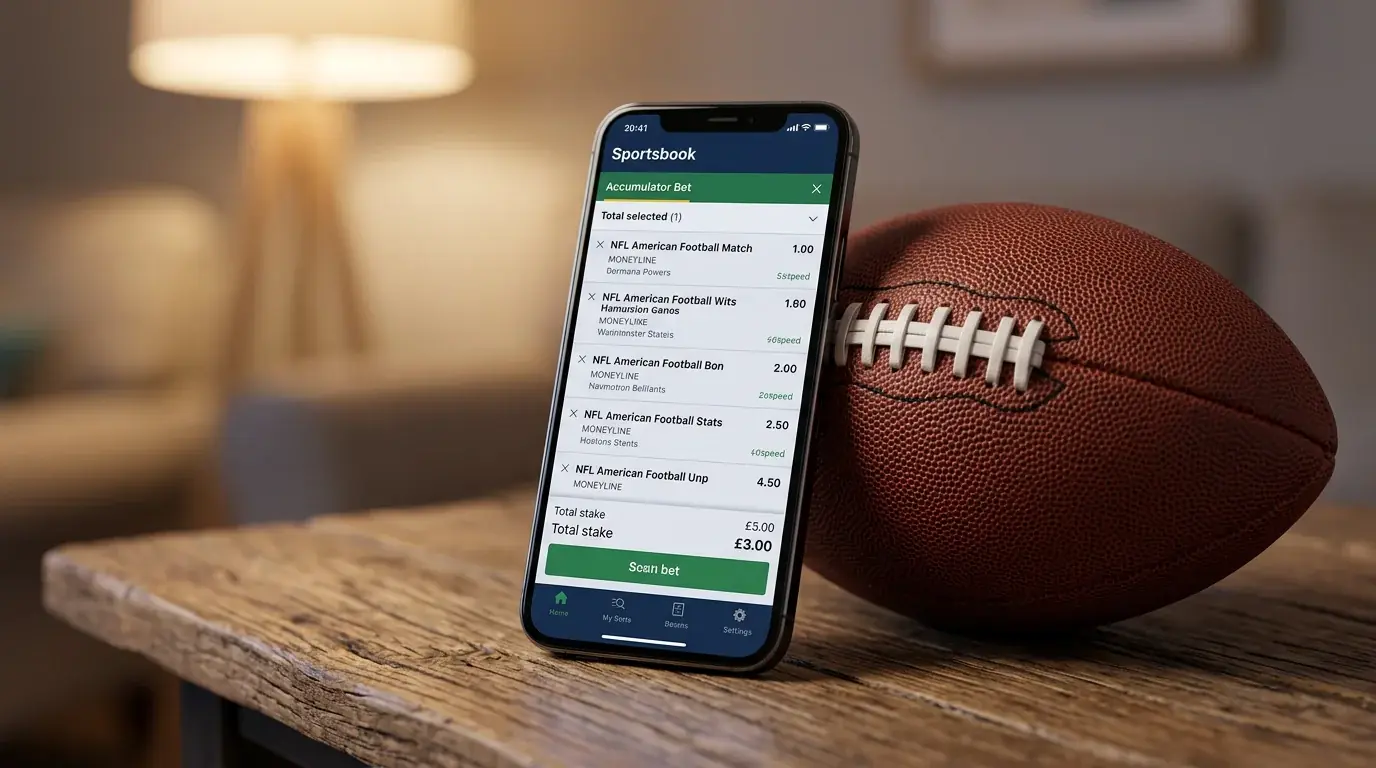
The single most common UK Super Bowl accumulator mistake is stacking correlated legs. Picking the favourite to win, the favourite to cover the spread, the over on the total, and the favourite’s quarterback to be MVP feels like four bets. It is, at most, two bets, because all four legs depend on roughly the same matchup view: the favourite plays well and the game is high-scoring. The accumulator price reflects the four legs as if they were independent, but the variance is much narrower than that price suggests.
What works better, and this is from running a few hundred Super Bowl accumulators over the past seven seasons, is mixing market types that are weakly correlated rather than strongly. A spread bet on the favourite, a totals bet on the under, a non-quarterback MVP pick, and a half-time leader bet on the underdog: that is four legs that do not all win or lose together. UK books have responded to the correlation issue by offering same-game multiples and bet builders on the Super Bowl, where the bookmaker explicitly prices in correlations between legs. The price is shorter than a naive accumulator would calculate, which is the bookmaker’s honest acknowledgement that the legs depend on each other.
One specific UK Super Bowl pattern worth knowing: most major operators offer enhanced or boosted accumulator prices on Super Bowl day, often promising a percentage uplift on a four-or-more-leg bet. Read these carefully. The boost is usually applied to the combined price, but the legs are sometimes at slightly shorter prices than the headline market. Boosts are not free money. They are price calibrations dressed as gifts. My own rule: maximum three legs, always combined within a single bet builder rather than as a multi-game accumulator, with at least one leg that is not directly correlated with the others.
UK tax position and Super Bowl-specific promotions
The good news, and it is the single most important piece of UK Super Bowl betting context, is that you do not pay tax on your winnings. The bookmaker pays gambling duty; you do not. Whether you win 50 pounds on a coin toss or 50,000 on an outright futures bet placed in August, the entire amount is yours to keep. UK gambling tax sits on the operator side, and that distinction matters because Super Bowl betting often produces unusually large single-event payouts.
The structural changes to UK gambling taxation are coming, and they will affect Super Bowl betting indirectly through pricing rather than directly through your tax bill. The Remote Gaming Duty is rising from 21 percent to 40 percent in April 2026, and the General Betting Duty for remote betting is moving from 15 percent to 25 percent in April 2027. Horseracing is excluded from the GBD increase, but NFL betting is not. The combined gambling tax changes are forecast to raise an additional 810 million pounds in the 2026-27 fiscal year. What that means for UK Super Bowl punters is that bookmakers will be running on tighter operating margins from April 2027 onwards, and the most likely place that pressure shows up is in promotional generosity.
On Super Bowl-specific promotions, the standard UK menu includes: enhanced first-touchdown-scorer prices, money-back-as-free-bet offers if specific events occur, boosted accumulator percentages, and money-back specials on losing first goalscorer or first touchdown markets. UK operator William Hill runs the “Drive 55” promotion as a permanent NFL feature, which gives a 15 percent free bet bonus on winnings from moneyline or handicap bets in matches where 55 or more total points are scored. BetUK and other licensed UK operators offer the 17-plus Early Payout, which settles winning moneyline bets if your team leads by 17 or more at any point.
One Super Bowl-specific wrinkle worth knowing: from January 2026, UK regulations cap the wagering requirement on bonus funds at 10 times, and mixed-product promotional offers were banned. That means Super Bowl free bets and promotional offers come with cleaner, more transparent terms in 2026 than in previous years. The trade-off is that the headline numbers on promotions are sometimes smaller, because the bookmakers are no longer obscuring the value behind complex wagering requirements. Read the terms anyway.
UK punter questions on Super Bowl betting
When does Super Bowl betting open at UK sportsbooks?
Super Bowl outright winner markets open the day after the previous Super Bowl ends, with all 32 teams priced for the following season. Match-specific markets — spread, totals, MVP, novelty — open the moment the conference championships conclude, which is typically two weeks before kickoff. Heaviest market depth, including most of the novelty offerings and bet builders, comes online in the final 48 hours before kickoff.
Are novelty Super Bowl markets settled like normal bets?
Yes, but the settlement criteria are usually defined more strictly than punters expect. Coin toss settles immediately. Anthem-length markets settle on the timing of the final note as defined by the bookmaker. Halftime show markets settle on the official setlist. UK-licensed operators are required to publish settlement rules before markets open, so check the specific T&Cs of any novelty market before placing — particularly for halftime and post-match interview bets, where definition disputes are most common.
Do UK bookmakers refund Super Bowl losing bets?
Some UK operators run money-back-as-free-bet offers on specific Super Bowl markets, where a losing first-touchdown-scorer or losing anytime-scorer bet may be refunded as a free bet up to a capped amount. These promotions are not universal and the terms vary by operator. Read the offer page in full before placing — typical conditions include a minimum stake, a maximum free-bet refund, and a wagering requirement on the free bet itself. Standard losing bets without a specific refund offer attached are not refunded.
Written by the editors at nfl Betting Markets.