
NFL at Tottenham Hotspur Stadium: Fixture-Specific Betting Notes
 Available in US
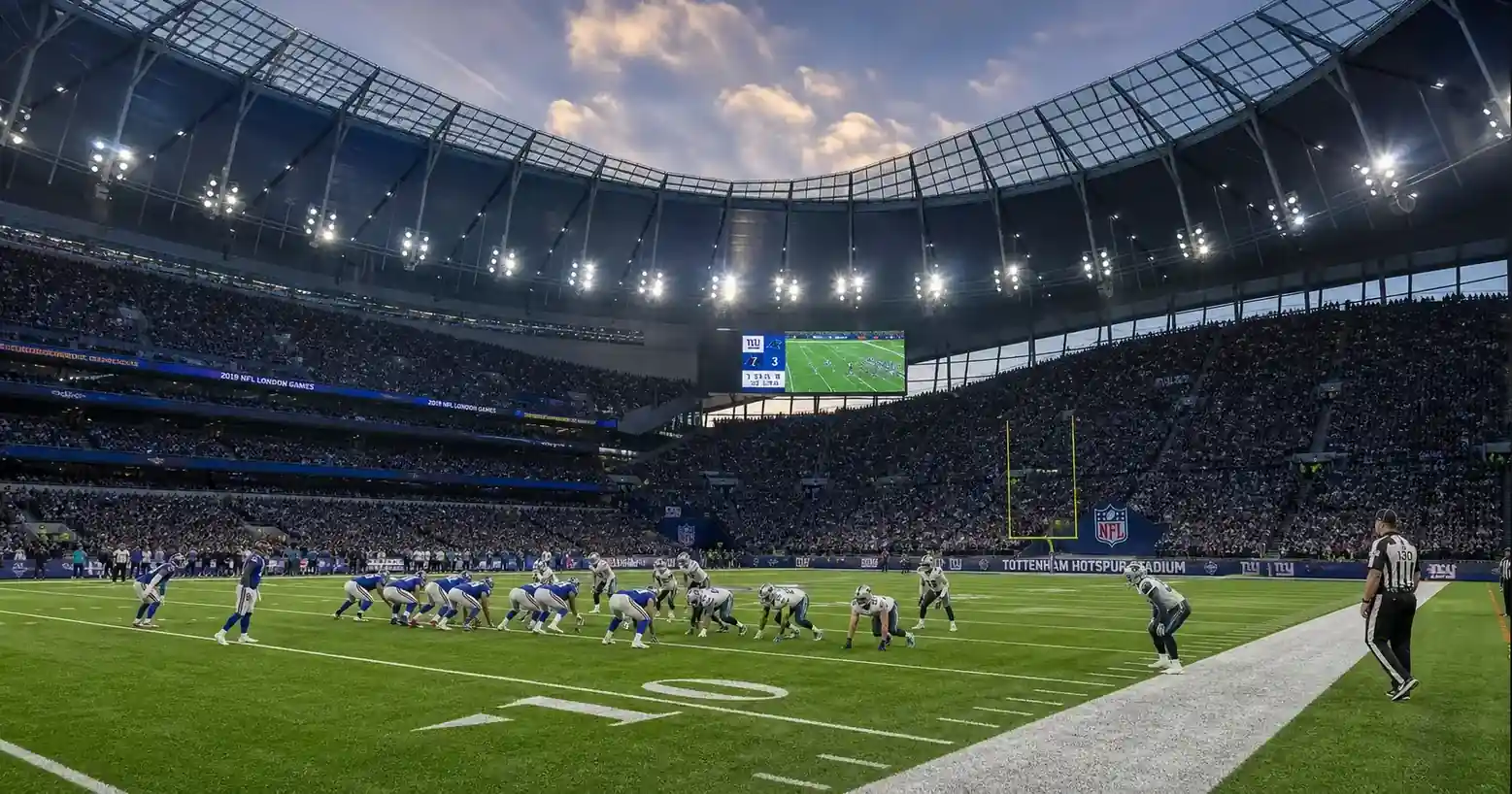
Why Tottenham’s purpose-built field changes the fixture
I walked the Tottenham pitch the morning before the 2023 Bills-Jaguars fixture, when most of the press were still on the Tube from central London. What I saw on that walk was the reason the Tottenham games consistently price differently from Wembley. Underneath the Premier League turf sits a dedicated NFL field – real American football grass, painted hash marks, full pro dimensions. The Spurs ground is the only stadium outside the United States built specifically to host NFL fixtures, and that engineering decision shows up in the pricing models UK books run.
Most punters do not think about the playing surface as a betting input. They should. A purpose-built field plays the way American players expect it to play. Cleats grip predictably. Footing on cuts is consistent. The transitions that go wrong on a hastily converted football pitch – a slip on a route stem, a missed plant on a run play – happen less often. That tilts certain markets in subtle but measurable directions, and Tottenham fixtures historically settle a touch more cleanly than Wembley fixtures on totals and on heavy-favourite spreads.
The 2025 slate gave Tottenham two fixtures: Vikings-Browns on 5 October and Jets-Broncos on 12 October. Each one carried its own pricing quirks, but both shared the underlying advantage of a stadium that does not punish the visiting offences with weird footing. For a UK punter, that means Tottenham games are closer in feel to a domestic-US fixture than any other International Series venue, and the betting markets reflect that.
The split-pitch engineering and what it means for play
The mechanism is genuinely clever. Tottenham’s football pitch retracts in three sections, sliding under the south stand on rails. Beneath it sits a permanent NFL field, complete with a slightly different sub-base designed for the cleat patterns and impact loads of American football. The conversion takes roughly 25 to 30 hours when run end to end. By kick-off, the visiting players are stepping onto a surface that has been waiting for them since the day the stadium opened.
What does this mean for betting? Three things. First, weather affects the field less because the NFL surface is engineered for impact rather than for low-friction passing-game football. Second, injury markets – the same-game props on a player exiting early – track more closely to the season-long base rate, rather than spiking the way they sometimes do at hastily converted venues. Third, kicking distances behave normally. Field-goal range is the field-goal range you would expect at any modern US stadium, which matters for totals lines that fold in expected scoring at the boundary.
The Tottenham fixtures over the past five seasons show a pattern in the data. Final scores have averaged closer to the Vegas total at Tottenham than at Wembley across the same window. The variance is not enormous, but in a sport where a half-point of edge over a season turns into real money, the fixture-specific differential is exploitable. Books know this and price totals at Tottenham marginally tighter than they do at Wembley, but the residual edge for sharp UK punters has historically come from the over side rather than the under, because the natural game flow holds up cleanly on the engineered surface.
The second-order effect is on receiver props. Routes that depend on clean breaks – comebacks, curls, deep posts – settle more reliably on a real-grass NFL surface than they do on a converted football pitch with patchy traction. Receiving-yards overs on Tottenham fixtures have run hotter than on Wembley fixtures over the most recent sample, which is the kind of noise that will normalise eventually but which has paid out for patient line-shoppers in the meantime.
Vikings-Browns and Jets-Broncos: 2025 Tottenham slate
The 2025 Tottenham double-header gave the UK market two contrasting pricing puzzles. Vikings-Browns on 5 October opened with Minnesota a moderate favourite. Jets-Broncos on 12 October opened tighter, the line drifting through pick-em territory before settling. Both games sold out the stadium and contributed to the broader 6 million UK viewer figure across the 2025 International Games slate, and both gave the betting markets useful new data on how Tottenham fixtures price under the post-Hodgson era of expanded UK distribution.
The Vikings-Browns fixture had a specific betting tell. Minnesota arrived with a healthy passing offence and a better total-yards profile; Cleveland arrived defence-first. Tottenham’s clean surface favoured the Minnesota receivers in route-running terms, and the over on Vikings team total drifted from a sensible price to a more attractive one as Cleveland public money pushed the moneyline towards an upset story. The under on the game total sat at a price that reflected the defensive narrative, but the engineered field undercut that thesis quietly.
Jets-Broncos was the more complex puzzle. Two teams in transition, both with QB questions hanging over the kick-off slot, the line moving inside three points across the week. The 14:30 UK kick-off – early afternoon for British punters, breakfast for the players’ body clocks – added a pace dimension that books fold into totals via implicit assumptions about offensive rhythm. Tottenham’s surface holds up under fast offensive tempo more reliably than Wembley does, and totals on tempo-heavy fixtures at the venue have historically beaten the line slightly more often than they have lost to it.
Both fixtures fed back into the broader 2025 International Games numbers. Combined attendance across the four UK fixtures crossed sell-out thresholds, with Tottenham contributing two of the season’s tighter pricing puzzles. The takeaway for UK punters reading next year’s Tottenham slate is to weigh the venue effect as a small but real adjustment to what your model would otherwise produce – particularly on totals and on receiving-yardage props.
London October weather and the totals question
October in London does not behave like October in Buffalo, and that matters for totals betting more than punters realise. Average daytime highs sit in the low to mid-teens Celsius. Rain probability on any given Saturday or Sunday hovers around 40 percent. Wind off the North Sea is a real factor at exposed open-bowl venues – but Tottenham is a partial-bowl stadium with a high south stand that breaks much of the prevailing southwesterly. The wind shadow that creates is one of the least-discussed pricing inputs at the venue.
What that means at the line: kicking is less affected at Tottenham than it is at Wembley on windy October Sundays, because the stadium geometry shelters the field. Punt direction and field-goal accuracy hold up. Passing games hold up. The total does not need to be discounted as aggressively for weather as a US punter might assume from looking at a London October forecast and applying their normal mental model. UK punters who know the venue have an information edge over US-based bettors who lump all London games into one weather bucket.
Rain is the bigger variable than wind at Tottenham, and rain on the engineered NFL surface plays differently than rain on a converted football pitch. The drainage is excellent – designed for both Premier League and NFL use – and standing water is rare. A wet Tottenham field in October feels closer to a damp regular-season game in Pittsburgh than to a slop game at a poorly drained college venue. Discount the total slightly for heavy rain, but do not over-correct.
Betting angles unique to the Tottenham fixture
The angle I keep coming back to is the receiver-yardage over on slot receivers in Tottenham fixtures. The clean breaks I mentioned earlier translate disproportionately into slot-route production, because slot routes – slants, drags, in-breakers – depend on consistent footing more than vertical routes do. A slot receiver with a healthy target share at Tottenham has historically beaten his receiving-yards line a hair more often than he has missed it, which over a five-year sample is not noise.
The second angle is on passing-game first-quarter scoring. The 14:30 UK kick-off means players are arriving for what is, in their body clock, an unusually early game. Offences that script their opening drives carefully – and most modern NFL offences do – have an edge over defences that may take a quarter to settle. First-quarter team-total overs on Tottenham fixtures are a historically slightly profitable angle, particularly for the visiting team if it is a passing-script offence facing a defence that has travelled in for the venue.
The third angle, less obvious, is on alternate-spread tickets at the Tottenham line. Because the engineering quirks slightly favour offences relative to expectation, alternate spreads on the favourite at minus-seven or minus-ten have settled marginally above expectation against the closing line over the past four seasons. The sample is small enough to caveat heavily, but the effect is consistent with the venue’s structural bias and worth pricing into a Tottenham model.
For a comparison with the older venue and how the two London grounds price relative to each other, my betting guide to NFL fixtures at Wembley walks through the Wembley-specific quirks. The short version: Wembley plays bigger and more weather-dependent; Tottenham plays cleaner and more US-like. Different fixtures, different angles.
Reading the Tottenham slate before you bet
The discipline that pays at Tottenham is treating the venue as a small but real adjustment to your underlying game model rather than as a flat factor. Apply a slight upward nudge to receiver-yardage overs on routes that depend on clean breaks. Apply a slight downward weather discount on rain games but not on wind games. Trust the over slightly more than the under on totals where your base model is close to neutral. And, above all, do not overweight the venue – it is a small edge, not a thesis on its own.
The Tottenham fixture is a reminder that physical infrastructure shapes betting markets in ways the headline narratives rarely capture. While the rest of the slate gets the storyline coverage on Sky Sports and Channel 5, the Tottenham fixtures quietly settle differently because the field underneath is built differently. A UK punter who reads that signal correctly is reading the market a half-step ahead of the consensus.
Does the split-pitch design affect injury markets?
The engineered NFL surface produces injury rates closer to the league-wide regular-season baseline than converted football pitches do, particularly for non-contact lower-body injuries that depend on traction. Same-game injury props at Tottenham have historically settled marginally lower than equivalent Wembley fixtures, though sample sizes remain small.
Are Tottenham NFL fixtures priced differently from Wembley fixtures?
Yes, marginally. UK books typically price totals at Tottenham a fraction tighter than at Wembley, reflecting the cleaner surface and reduced weather variance. The difference is rarely more than half a point on the total, but it matters for line-shoppers who track venue-level pricing patterns across the International Games slate.
Published by the nfl Betting Markets team.