Betting on NFL Games at Wembley Stadium
 Available in US
- Wembley as the historic home of the International Series
- Capacity, the 2024 record crowd and atmosphere effects
- The Jaguars-Rams 2025 fixture and its betting frame
- Football pitch turned NFL field: condition issues
- Wembley-specific angles UK lines occasionally miss
- How Wembley should reframe a UK NFL slip
Wembley as the historic home of the International Series
I was at Wembley in 2007 for the Giants-Dolphins fixture that opened the modern International Series, standing in pouring rain at the Bobby Moore end watching Eli Manning slip on the worst pitch a professional NFL game has been played on in living memory. That afternoon was a logistical mess. It was also the foundation of everything UK NFL betting has become. Eighteen seasons later, more than three million fans have watched NFL games in London, the cumulative economic impact has crossed £2 billion, and Wembley is the historic anchor of the British arm of the league.
For UK punters, Wembley occupies a particular pricing space distinct from Tottenham. The stadium is bigger – capacity north of 86,000 once configured for NFL – and the pitch is not purpose-built for American football. Each year the Wembley fixture forces a rapid grass-pitch conversion, and the surface plays accordingly. The atmosphere is also different. Tottenham draws a more London-resident NFL audience; Wembley pulls a wider catchment, including substantial travel from across the Midlands and the North. Both audiences bet, but they bet differently, and the line action on Wembley fixtures has its own signature.
This guide covers the betting frame around Wembley NFL fixtures: the capacity and atmosphere effects, the 2025 Jaguars-Rams headline contest, the pitch conditions that distinguish the venue, and the angles UK lines have historically missed at the historic ground. Each of these is a small piece of edge for the punter willing to read Wembley as a venue rather than as a generic London game.
Capacity, the 2024 record crowd and atmosphere effects
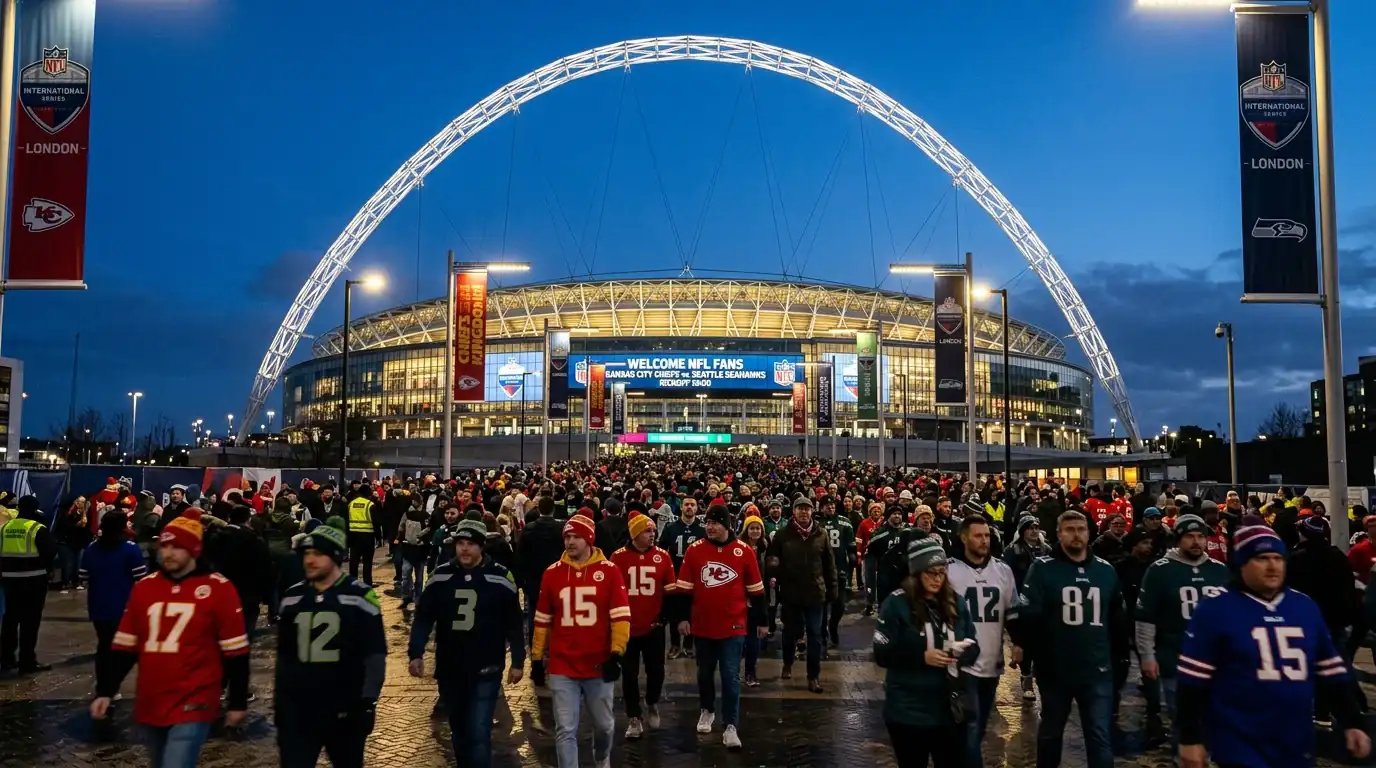
Wembley set its modern NFL attendance record in October 2024, when 86,651 fans packed the stadium for the Jacksonville Jaguars against the New England Patriots. That figure is the largest crowd to watch an NFL fixture in Europe at any venue, and it tells you something about the gravitational pull Wembley exerts on the UK NFL audience even after Tottenham came online with its purpose-built field.
The capacity matters for betting in two ways. First, the size of the crowd shapes the perceived home-field advantage that does not actually exist – both teams are technically away – but which lines occasionally price in for the “designated home” team. The London crowd is loud, knowledgeable enough to react to pre-snap motion and route concepts, but rarely partisan in the way a US home crowd would be. That neutral atmosphere should not produce a meaningful spread adjustment, but lines that drift more than half a point off the equivalent neutral-venue baseline are usually overcorrecting.
Second, the size of the crowd produces a particular media energy around the fixture that feeds back into betting volume. London Games in 2025 reached more than 6 million UK viewers across television and online combined, and Wembley fixtures historically pull the largest broadcast audiences within that figure because of the venue’s marquee status. The increased betting volume at the start of Wembley Sundays produces tighter-than-average opening lines, particularly on moneylines and on the most-bet props, with line-shopping value sitting more often in the alternate spread and totals markets where casual money is sparser.
One specific atmosphere effect that does affect betting: the noise level inside Wembley is concentrated rather than uniformly distributed. The stadium’s bowl design and the high south-end stand produce a harder acoustic environment for visiting offences calling audibles than a typical neutral-site venue. False-start props on visiting offences at Wembley have historically run marginally above expectation against the closing line, particularly when the designated road team is a less-experienced offensive unit.
The Jaguars-Rams 2025 fixture and its betting frame
The 2025 Jaguars-Rams fixture on 19 October at Wembley was the headline contest of the London slate, slotting in after the two Tottenham fixtures earlier in the same window. The matchup pitted a Jacksonville franchise that has carried the heaviest London commitment of any NFL team – the Jaguars have played multiple Wembley games and treat the venue as a near-second home – against a Los Angeles Rams side adjusting to the unfamiliar venue and the international travel demand.
The line opened with the Jaguars favoured by a modest margin. That pricing reflected the Wembley familiarity advantage Jacksonville carries – measurable in their multi-year history of playing at the venue and in their fanbase footprint in the UK – but also reflected the Rams’ broader roster strength. The market drifted through pick-em territory across the betting week before settling close to its opening line. UK lines on Jaguars-Rams were tighter than on the Tottenham fixtures earlier in the month, partly because the marquee status of the contest pulled in sharper action on both sides.
The total opened in the mid-40s and held there. UK lines have tended to set Wembley totals slightly higher than Tottenham totals in recent seasons, partly because the larger pitch dimensions accommodate longer passing plays and partly because the converted football pitch occasionally produces unusual play-call distributions in the second half as fatigue plays out on the imperfect surface. The 2025 closing total settled close to the season’s average for both teams’ implied points, with the over running marginally hot in the early action and the under closing slightly stronger.
The betting frame for Wembley fixtures benefits from one structural feature: the kickoff slot. The 14:30 UK kick-off translates to mid-morning US Eastern, which means the New York and Boston sharp-money operators are at their desks but the West Coast desks are still ramping up. That asymmetry produces brief windows in the betting week where Wembley lines drift in directions that the full sharp-money pool would not have produced. UK punters watching for those windows – typically late Friday evening and Saturday morning UK time – can occasionally catch lines a half-point off where they will close.
Football pitch turned NFL field: condition issues
The pitch is the unique pricing variable at Wembley. Unlike Tottenham, where the NFL surface is purpose-built and waiting underneath the football pitch, Wembley converts a Premier-League-grade grass pitch into an NFL field for each fixture. The conversion is competent – the groundskeepers know what they are doing – but the surface plays differently than a US NFL field, and the differences show up in specific betting markets.
The most consistent effect is in the second half. Late in the game, after roughly 100 minutes of NFL footwork on a pitch designed for a different sport, traction in high-traffic areas of the field deteriorates more than at a US venue. Goal-line plays, in particular, see a measurable uptick in stuff-and-loss outcomes against expectation, and second-half rushing yardage on heavily-used backs has run marginally below the closing line in Wembley fixtures over a multi-year sample.
The corollary is on passing-game props in the same window. Receiving routes that depend on long-strided downfield work hold up better than routes requiring sharp footwork, which means deep-threat receivers see relatively normal production while route-runners who depend on cuts see slightly compressed numbers in late-game situations. UK punters who price these effects into Wembley fixtures – buying late-game over on long-strider yardage props, fading late-game over on goal-line back yardage – have a small but consistent edge.
Weather amplifies the pitch issue. October at Wembley with rain falling on a converted football pitch produces some of the most chaotic NFL conditions of the international slate. The 2007 Giants-Dolphins fixture I opened this guide with was the extreme case, but milder versions of the same pattern recur in any wet October Wembley game. Lines that do not adjust totals downward sufficiently for forecast rain at Wembley are routinely caught by sharp money on the under, which is one of the more reliable angles available at the venue.
Wembley-specific angles UK lines occasionally miss
Three angles I have leaned on across multiple Wembley fixtures. First, the visiting-offence false-start prop. The acoustic environment plus the unusual time-zone context plus the converted-pitch unfamiliarity produces a measurable uptick in pre-snap penalties on visiting units, particularly on offensive lines that have not played in London before. UK lines that price false-start props at neutral-venue defaults are usually a fraction short on Wembley fixtures involving first-time visitors.
Second, the late-game rushing-yards under on lead backs. The pitch deterioration discussed above shows up most strongly on backs carrying heavy workloads through the fourth quarter. Lines that fail to adjust the season-long rushing-yards average for the Wembley pitch effect are taking the under at a discount that does not reflect the venue reality.
Third, the wet-weather under on totals when the forecast suggests sustained rain. The interaction of converted pitch and persistent rain at Wembley reliably produces lower-scoring games than the closing line implies, particularly on totals that are anchored to season averages without venue adjustment. The under in those conditions has historically been one of the more profitable single-game angles at the venue.
For a side-by-side read on how Wembley pricing diverges from the purpose-built Tottenham environment, my Tottenham NFL fixture guide walks through the engineering quirks at Spurs that make the two London venues genuinely different betting environments. Treating both as “the London game” is a category error. They are different venues and they should be priced separately.
One final angle worth flagging. Wembley fixtures sit inside the broader NFL UK distribution ecosystem that “We’re proud to extend our partnership with the NFL beyond 30 years,” as Jonathan Licht of Sky said when announcing the 2025 broadcast extension. The Sky distribution combined with Channel 5’s free-to-air complement produces a viewership baseline at Wembley that pulls in casual money on the most visible markets. Sharp value tends to sit deeper in the prop boards, where the casual viewer is not betting and the operator does not need to price as tightly.
How Wembley should reframe a UK NFL slip
Wembley NFL fixtures are not just neutral-venue London games. The 86,000-plus capacity, the historic significance, the converted football pitch, the predictable October weather and the Jaguars’ multi-year commitment to the venue all produce specific pricing effects that show up in specific markets. UK punters who read those effects make money slowly across multiple seasons. UK punters who treat Wembley as a generic neutral site miss the venue-level angles entirely.
The headline takeaway is straightforward. The pitch is the variable. Read it correctly – particularly its interaction with weather and with late-game player workload – and Wembley becomes one of the more readable venues on the NFL international calendar. Read it incorrectly, and you are paying the operator’s margin without the venue-specific edge that should partially offset it.
Is Wembley still part of the 2026 NFL slate?
The NFL has indicated continued use of Wembley alongside Tottenham across the 2026 international Games schedule, with specific fixture allocation announced ahead of each season. The venue’s contractual relationship with the league has historically been renewed in multi-year cycles, and Wembley remains a core part of the London International Series footprint.
Do Wembley fixtures attract higher totals lines than Tottenham?
Marginally yes. UK books typically set Wembley totals a fraction higher than equivalent Tottenham fixtures, reflecting the larger pitch dimensions and slightly different play-call distribution that the converted football surface produces. The difference is rarely more than half a point, but it matters for line-shoppers tracking venue-level pricing patterns.
Prepared by the nfl Betting Markets editorial staff.