UKGC-Licensed Operators for NFL Betting: How to Verify Before You Bet
 Available in US

Why a UKGC licence is the floor, not the ceiling
A reader emailed me last August about a sportsbook offering NFL price boosts that looked too generous to be real. Welcome bonus, no wagering requirement on the free bet, NFL-specific reload offers stacked weekly. He had signed up, deposited £200, won a small four-leg accumulator, and then spent three weeks trying to withdraw. The site, he discovered after checking, held no UKGC licence. It was a white-label running on a Curaçao authorisation with a domain hosted offshore. The withdrawal never happened.
That story is the reason I treat UKGC licensing as the absolute floor for any NFL bet I place from the UK. Not a marketing badge. Not a “nice to have.” The licence is the only enforceable consumer protection sitting between you and an operator that decides not to pay. The UK Gambling Commission has the legal authority to compel an operator to honour bets, return funds, and submit to dispute resolution. No offshore regulator has equivalent reach into a UK customer’s protection.
The licence is the floor, though, not the ceiling. A UKGC-licensed sportsbook can still offer poor pricing, slow withdrawals, sketchy customer service, and unfair voiding rules within the limits of what the licence allows. Reading the licence as a guarantee of quality is a mistake. Reading it as a baseline of legal recourse is correct. Operators that fall below the floor – unlicensed, offshore-only, or operating on a hybrid white-label that obscures the licensing chain – should never get your money, regardless of what they offer at the front end.
This guide walks through how to verify a UKGC licence in under sixty seconds, what the operator-data reporting regime introduced in July 2024 changed about transparency, the compliance signals that distinguish a serious UK NFL bookmaker from a marketing-led one, and the red flags that should make you walk away from a site even if the welcome offer looks attractive.
How to check a sportsbook’s UKGC licence
The verification mechanic takes under a minute and there is no excuse for skipping it. The UK Gambling Commission maintains a public register of every operator licensed to offer remote gambling to UK customers. The register is searchable by operator name, by licence number, and by URL. Any sportsbook claiming to be UKGC-licensed must display its licence number in the footer of its website, and that number must match the public register exactly.
The check itself: scroll to the footer of the sportsbook. Find the licence statement, which should read something like “Licensed and regulated by the Gambling Commission under account number” followed by an eight-digit reference. Note the number. Open a separate browser tab. Search the UKGC public register for that number. The register entry will show the licensee company name, the trading names authorised under the licence, the activities permitted, and the date the licence was granted.
Three things should match. The trading name on the register should match the brand name on the sportsbook. The website URL should be listed among the authorised domains for that licence. And the activities permitted should explicitly include remote sports betting. If any of those three fails – wrong company, missing URL, no betting activity authorised – the site is not safely UKGC-covered for your NFL wager and you should walk away.
One subtlety. Some legitimate UK operators run multiple brands under one licence. A parent company licensed by UKGC may operate three or four sportsbook brands, each on its own URL but all sitting under the same licence number. The register entry will list all authorised trading names. If you check a brand and the parent company is unfamiliar but the parent company’s licence is in good standing, the brand is legitimate. The check is not “do I recognise this name” – it is “is this URL on the register entry.”
The operator-data reporting regime since July 2024
From 1 July 2024, the largest UKGC-licensed operators – those representing roughly 70 percent of UK gambling market share – became subject to a quarterly operator-data reporting requirement. The reporting calendar is harmonised across four standard quarters: 1 April to 30 June, 1 July to 30 September, 1 October to 31 December, and 1 January to 31 March. Operators in scope submit detailed activity data to the UKGC inside short windows after each quarter closes, and the Commission aggregates and publishes industry-level statistics from that data.
The change is structural. Before July 2024, the Commission relied on annual operator returns and ad-hoc surveys to build its industry view. The data was lagged, partial, and often non-comparable across operators. After July 2024, the largest operators report on a defined schedule with defined fields, and the Commission has a near-real-time view of betting activity, customer behaviour, and harm indicators across the bulk of the regulated market. That visibility is the regulatory substrate underpinning everything else – financial risk assessment, deposit-limit prompts, levy enforcement, the lot.
For NFL bettors, the practical reading is that the operators carrying the bulk of UK NFL handle are now under a tighter regulatory lens than they were two years ago. Gross gambling yield in the UK ran at £12.6 billion across the customer-facing industry for the financial year ending March 2025, and the operators reporting under the new regime account for the lion’s share of that figure. Their NFL betting activity is visible to the regulator quarterly, and any patterns that suggest harm – accelerating losses, vulnerable-customer indicators, dispute volumes – surface to the regulator faster than they used to.
The transparency cuts both ways. Operators have less room to obscure their behaviour from the regulator, but they also have less room to obscure it from sophisticated punters reading the published industry data. The aggregate statistics released by the Commission give a clearer view of NFL market growth, in-play share, prop betting volume, and operator concentration than was available before, and that visibility is part of why this guide can speak with confidence about market structure.
Signals of a compliant NFL bookmaker
The compliance signals I look for in a UK NFL sportsbook are mostly visible on the surface if you know what to look for. The licence number is the start. After that, four further signals tell you whether the operator is serious about its UK obligations or running a thin compliance posture behind a heavy marketing front.
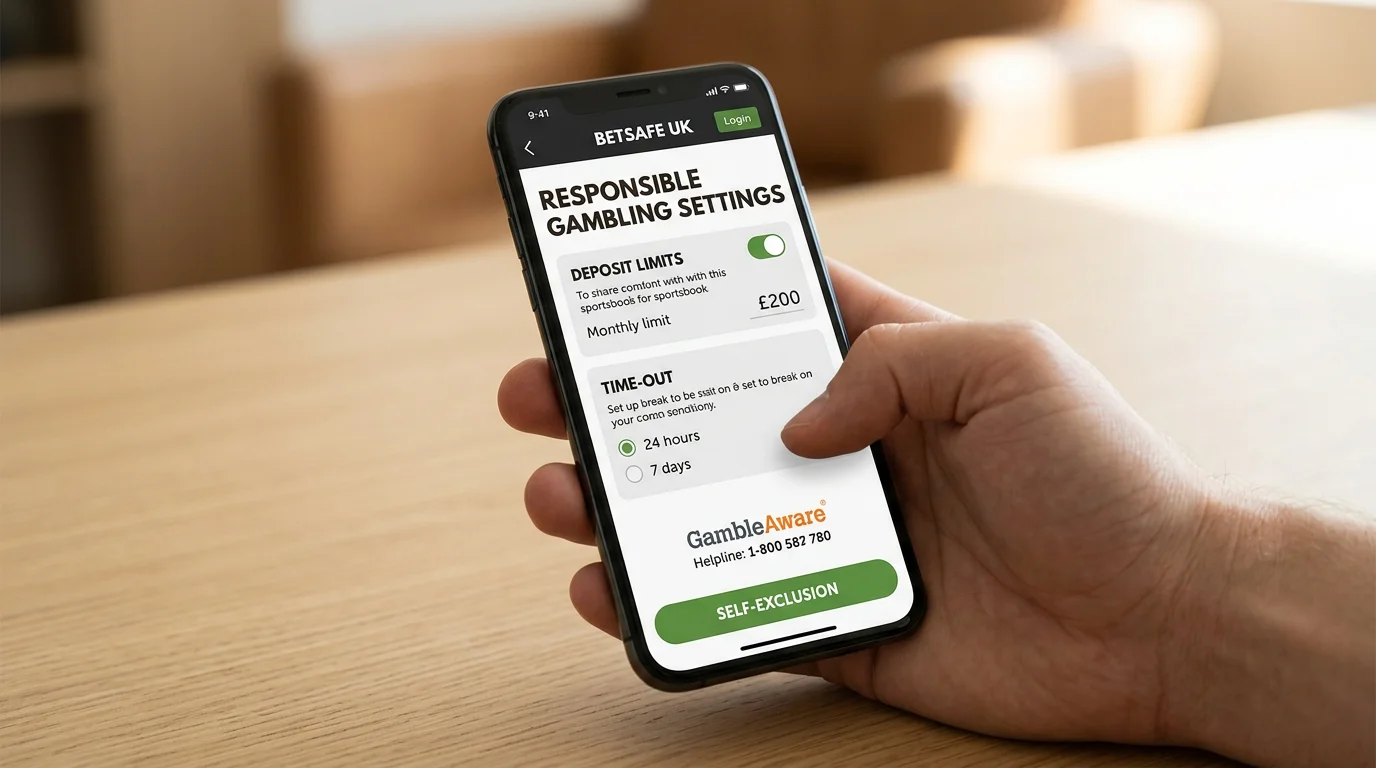
Signal one: the responsible-gambling page is more than a banner. A serious UK operator carries detailed self-exclusion information, working links to GAMSTOP, and explicit deposit-limit and reality-check tools accessible from the account dashboard rather than buried three menus deep. The page is updated for current regulations – including the 31 October 2025 deposit-limit prompt requirement – rather than reading like a 2022 template.
Signal two: the terms and conditions specify settlement rules clearly. NFL-specific rules – overtime handling on yardage props, void rules on weather-shortened games, push handling on key-number spreads – are spelled out rather than glossed. Operators who hide settlement rules behind vague language are operators who plan to use ambiguity in their favour when a dispute arises. Operators who specify the rules clearly are operators willing to be held to them.
Signal three: customer service is reachable on multiple channels, including phone or live chat, with response times that look like working hours rather than a single overnight inbox. The operator publishes complaint procedures and lists the alternative dispute resolution provider it uses. ADR access is a UKGC licensing requirement, and operators that bury the link or use an obscure provider are operators with something to hide.
Signal four: the technology behind the live product is current. Genius Sports’ BetVision, launched in September 2023, integrates low-latency NFL video with the bet slip in a way that reduces market suspension frequency and supports cleaner in-play settlement. Operators using current-generation streaming and pricing infrastructure can be identified by the smoothness of their live product. Stuttering streams, frequent market suspensions, and lagged price updates are indicators of older infrastructure that may also correlate with weaker compliance posture.
Red flags of an unlicensed offshore site
“Britain has one of the safest gambling markets in Europe,” Grainne Hurst said at a 2025 industry forum, “but if the Treasury isn’t careful, we could quickly end up like France or Sweden, with huge black markets contributing nothing in tax, offering zero player protection, and providing no funding for sport or the economy.” That black-market warning is the single most important reason to recognise unlicensed-operator red flags before they cost you money.
Red flag one: no UKGC licence number visible in the footer, or a licence number that fails the public register check. This is the dispositive flag. If the number does not match, walk away. There is no scenario in which “I just signed up and the site looks fine” overrides a failed register check.
Red flag two: deposit methods that include only crypto, gift cards, or unusual e-wallets without the standard UK debit card and licensed e-wallet options. UK-licensed operators are subject to the credit-card deposit ban and to regulatory oversight on payment processing. Sites missing the standard licensed payment rails are sites that cannot meet UK financial-compliance requirements, which is the same as saying they are not licensed.
Red flag three: aggressive welcome bonuses with no UK-compliant wagering requirements, or wagering requirements that exceed the 10x cap that comes into force across UK-licensed operators on 19 January 2026. An offshore site offering “300 percent welcome bonus, 50x wagering” in March 2026 is not playing by UK rules. The headline number looks attractive precisely because the small print is designed to make withdrawal impossible.
Red flag four: contact details that resolve to overseas registrations only, with no UK office and no UK contact mechanism. Some legitimate UK-licensed operators have parent companies registered offshore, but the licence requires a UK contact pathway. Sites that route every contact channel to Curaçao, Malta non-UK-tier addresses, or unspecified international support are sites without UK-side accountability.
The UKGC enforcement effort against the illegal market received an additional £26 million in funding over three years from the Autumn Budget 2025, which is the budget side of the same warning Hurst made publicly. The unlicensed black market is a real concern for both regulators and licensed operators, and the safest punter-side response is to verify the licence on every new account before any deposit clears.
For the parallel side of the operator picture – what licensed operators are actually required to provide in responsible-gambling tools – my guide to responsible gambling tools walks through the deposit limits, time-outs, GAMSTOP integration and Financial Risk Assessment infrastructure that every UKGC-licensed NFL bookmaker must offer.
Building the licensed-only habit
The single most valuable habit a UK NFL punter can build is the sixty-second licence check before any new account opens. UKGC public register, licence number match, URL on the authorised list, betting activity confirmed. If any of those four steps fails, the site does not get your deposit. The discipline costs less than a minute and saves you from the kind of withdrawal black hole that swallowed my reader’s £200 and any winnings he had built on top of it.
Beyond the licence check, the compliance signals – responsible-gambling depth, terms clarity, customer service reachability, live-product technology – separate the serious UK operators from the thin-compliance ones. Use those signals to choose where you keep your accounts. The licence is the floor; the signals are the ceiling. A UK NFL punter operating with both in mind is the punter who never has to email anyone about a withdrawal that did not arrive.
Can a UKGC licence be revoked mid-season?
Yes. The UK Gambling Commission can suspend or revoke an operator’s licence at any time for serious breaches of the licence conditions, and revocations have happened during active sports seasons. Customer funds at a revoked operator are protected through the segregated-account rules, but withdrawal processing can be delayed during the wind-down. Checking licence status periodically, not just at sign-up, is sensible practice.
Do all major NFL bookmakers hold a UKGC licence?
Every UK-facing operator legally accepting NFL bets from UK customers must hold a UKGC remote betting licence. The largest brands serving the UK market – including those visible in mainstream NFL advertising – are licensed. Sites accepting UK customer bets without a UKGC licence are operating illegally regardless of where they are based.
Created by the ”nfl Betting Markets” editorial team.