UK NFL Fan Demographics: The Audience Beneath the Bets
 Available in US

The most useful conversation I had about the UK NFL audience this year was not with an executive or a broadcaster but with a school teacher in Manchester whose Year 8 group runs a flag football club at lunchtimes. She told me her kids could name more NFL receivers than Premier League midfielders. I checked. She was right. That is the demographic story of UK NFL fandom in 2026, and the betting market that prices itself off this audience needs to understand who is actually watching, where they live and how they got here.
The Total Fan Base in Hard Numbers
Start with the headline figure. The NFL’s UK fan base now sits at 17.3 million followers, with 3.3 million classified as avid fans. The 17.3 million number includes anyone who follows the league with some level of engagement – watches games, tracks scores, knows team names. The 3.3 million avid number captures viewers who watch regularly through the season, follow specific teams, and engage with NFL content beyond the broadcast itself.
For context, the avid figure of 3.3 million places UK NFL fandom between cricket and rugby league in the UK sports hierarchy and within reach of motorsport. That positioning matters because it places the NFL in a category where dedicated betting markets, broadcast partnerships and merchandising operations all become commercially viable at scale. A 3.3 million avid base is no longer a niche audience. It is a mid-tier UK sport with growth momentum that most established UK sports do not have.
The betting market mirrors the demographic split. Casual fans bet around fixed touchpoints – Super Bowl, London games, the occasional Monday night marquee. Avid fans bet across the regular season, often weekly, often in-play. UK sports betting GGY sat at roughly £2.48 billion in 2026, with NFL representing a small but rapidly growing slice of that total. The disproportionate growth comes from the avid 3.3 million, not from the broader 17.3 million.
Why the Age Distribution Looks Different from America
Thirty-three percent of UK NFL viewers are under 35. The equivalent US figure is 17%. That is not a small difference. It is roughly double the proportion, and it is the single most important demographic divergence between the UK and US NFL audiences.
The reason for that skew is straightforward. UK NFL fandom did not grow out of childhood Sunday afternoons watching dad’s team. It grew out of late-night Sky broadcasts in the 1990s, the launch of Game Pass, the social-media era highlights culture, and the London games from 2007 onwards. The pathway in for a typical UK NFL fan is digital, late-evening and self-discovered. That pathway naturally attracts a younger cohort, and the demographic skew has compounded as social platforms have replaced cable as the primary content discovery layer.
That skew matters for betting. A 25-year-old UK NFL fan who discovered the league through TikTok highlights bets differently from a 55-year-old who picked it up watching Channel 4 in 1986. The younger cohort prefers mobile-first apps, in-play markets, anytime touchdown scorer bets and same-game multis. Seventy-six percent of UK 18-24 year olds use mobile for gambling, and within the NFL betting market that figure is even higher.
The under-35 dominance also explains why prop markets and novelty bets perform better in the UK NFL space than they do for older-demographic British sports. A bettor who has been watching for five years has the contextual knowledge to read a prop market. A bettor who has been watching for thirty years often does not need props to enjoy the game. The UK audience structure leans toward the former.
The Flag Football Pipeline No One Is Pricing
I asked an NFL UK executive last year why they kept funding flag football programmes when the commercial return was not obvious. The answer surprised me. They were not building it for the next twelve months. They were building it for the next twelve years.
The current youth flag football participation figure in the UK has reached roughly 100,000 children. Brent Hodgson framed it directly when discussing the league’s UK strategy: NFL UK has worked to “build a pipeline of fans through flag football, fan zones and academic partnerships.” That pipeline produces three things: future ticket buyers for London and Dublin games, future Sky and Channel 5 subscribers, and future bettors who will arrive in the regulated market with a structural understanding of the sport.
One hundred thousand children playing flag football in 2026 is a leading indicator for the UK NFL audience in 2032 to 2034. Not all of them will become fans. Maybe 20%. That is still 20,000 fans whose path into NFL fandom went through actually playing the game rather than passively watching it. Active participants tend to become avid fans rather than casual ones, and avid fans drive the disproportionate share of the betting market.
This is the part of the UK NFL audience demographic that almost no betting model accounts for, because it is invisible in the current numbers. The kids playing flag football today are not in the 17.3 million fan figure. They are not in the 3.3 million avid figure. They are not in the Super Bowl viewership data. They will be in all three within a decade, and they will be the audience the betting market grows to fit.
How the Bettor Overlap Works in Practice
Forty-seven percent of UK adults gamble in some form, and the sports betting share of that figure is heavily weighted toward male participants. Roughly 15% of UK men report sports betting activity in the last quarter, against 4% of UK women. Within the UK NFL audience that gender split is narrower than for football, partly because the UK NFL viewer base is younger and partly because Super Bowl viewing in particular has driven female engagement growth that filters into season-long viewership.
The overlap between UK NFL fans and UK sports bettors is not 100%, and it is important not to over-index on the betting share when modelling audience size. Of the 3.3 million avid UK NFL fans, my working estimate is that roughly 40 to 50% engage with betting markets at some point during a season. That gives a UK NFL betting audience of around 1.3 to 1.6 million people – which sounds modest until you remember that the same audience drives the Super Bowl handle spike, the London game prop market widening, and the steady regular season volume that operators now price for.
The remaining 1.7 to 2.0 million avid fans who do not bet are not lost to the market. They are the future betting audience that will be activated by the friction-reduction work the regulated market is doing – frictionless financial risk assessments for 97% of bettors, deposit-limit prompts that have become a normal part of account opening, and operator product investment in mobile-first NFL betting. Some will activate. Some will not. The size of the activated cohort is what determines NFL handle growth in the UK over the next three seasons.
The London Effect on Regional Distribution
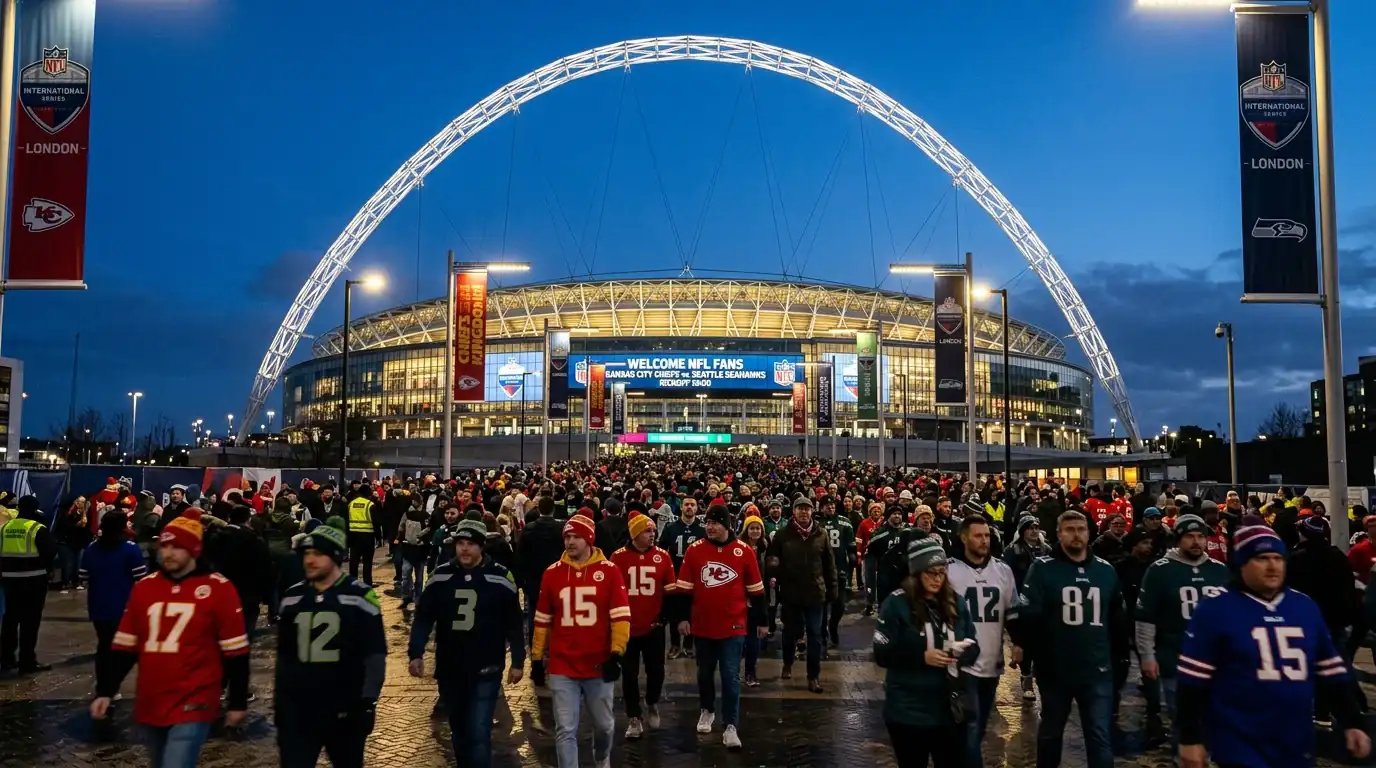
One last demographic dimension worth understanding is regional. UK NFL fandom is not distributed evenly across the country. It is heavily skewed toward London and the South East, with secondary clusters in Manchester, Birmingham, Glasgow, Edinburgh and Belfast. The London game series since 2007 has reinforced rather than corrected that skew, because every additional London fixture deepens the fan relationship in the Greater London catchment area.
The Tottenham-Wembley fixture pipeline, plus the Dublin debut at Croke Park, has begun to broaden that distribution. Dublin in particular pulled an audience from Northern Ireland, Scotland and the north of England that was not historically tied to the London game ecosystem. The Madrid debut later in 2025 added a non-UK European leg that affects UK travel-pattern fans without directly touching UK domestic audience data.
For betting purposes, the regional skew matters because it shapes where operators acquire NFL customers. London-based bettors are more likely to attend live games, more likely to bet on London fixtures specifically, and more likely to engage with operators that have a visible presence at the Tottenham and Wembley venues. If you want to understand more about how the broadcast infrastructure interacts with this audience, the related UK Super Bowl viewership trends piece covers the demographic shifts that have driven the audience expansion across the past decade.
What This Audience Becomes Next
Pull back from the individual data points and the picture is coherent. The UK NFL audience is younger than its US equivalent, growing faster than most UK sports, regionally concentrated but broadening, female-engaged at the Super Bowl peak, and underwritten by a youth participation pipeline that will not show up in the betting market for another decade. The 17.3 million followers and 3.3 million avid fans are the visible part. The flag football kids, the Channel 5 free-to-air audience entrants from 2025 onwards, and the Tottenham matchday newcomers are the part that determines what these numbers look like in 2030.
The bettor inside that audience is changing too. Younger, more mobile-led, more comfortable with in-play and prop markets, more responsive to social-platform-driven content. The operators that are winning UK NFL market share are the ones that have built product for that bettor rather than for a 1990s Sunday-afternoon-football archetype. The audience is telling them what to build. The numbers are clear enough that the message is hard to miss.
How is NFL fandom in the UK actually measured?
The figures cited come from a mix of league-commissioned audience research, broadcaster reach data and viewership panels. The 17.3 million followers and 3.3 million avid fans are NFL UK’s own published figures, derived from market research that classifies engagement by frequency of viewing, awareness of teams and players, and self-reported fan affiliation. Broadcast viewership numbers from Sky and Channel 5 cross-reference these figures and provide event-specific verification.
Are women genuinely the fastest-growing UK NFL fan segment?
Female engagement has grown sharply at the Super Bowl peak, with Sky reporting a 93% year-on-year rise in female viewership for Super Bowl LVIII. Year-round female fandom is growing more steadily, with younger demographic cohorts showing the most pronounced gender rebalancing. Whether the rate of growth in female fandom now exceeds male growth depends on which segment you measure – Super Bowl-only, regular season, or avid fan classification – but the directional trend is clearly upward across all three.
Published by the nfl Betting Markets team.