NFL Half-Time Betting in the UK: The Live Window That Most Punters Misuse
 Available in US
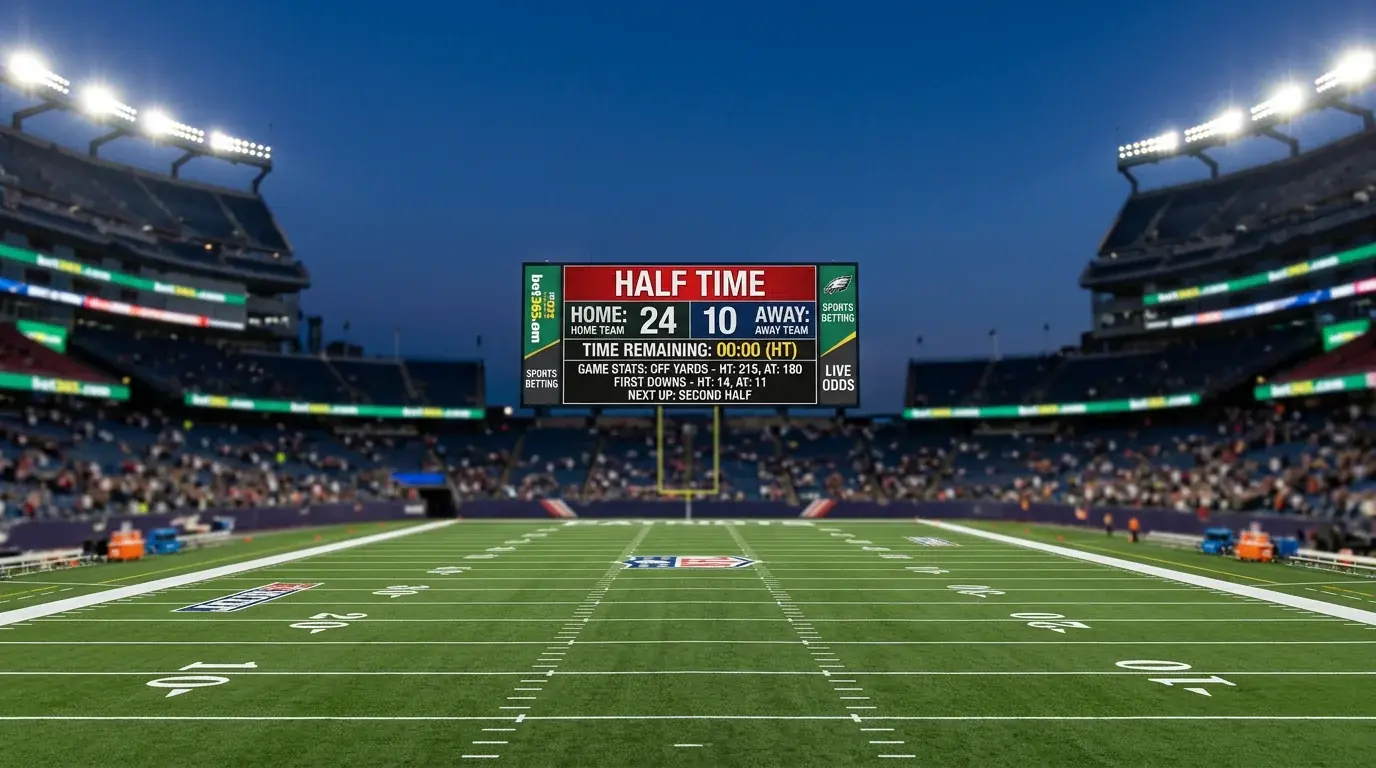
Half-time of an NFL fixture is the most concentrated decision-making window in live UK NFL betting. The break runs roughly twelve minutes for a regular-season game and around thirty for the Super Bowl, and within that compressed window every UK-licensed operator reposts a full second-half betting menu – second-half spread, second-half total, third-quarter winner, second-half team totals, and an array of derivative props. Live and in-play betting accounts for approximately 62.35% of online sports betting share in 2025, and the half-time window is the structural pivot point where that in-play volume concentrates most heavily on a typical NFL Sunday. Understanding how to read these markets, rather than reacting to them, is one of the higher-value structural skills a UK NFL bettor can develop.
How Second-Half Lines Are Constructed
The second-half line is not a static halving of the pre-game line. Operator pricing engines reconstruct the second-half spread and total from scratch using the first-half result, the current pace of play, the recorded injury and personnel adjustments, and the projected second-half rotation patterns. The resulting line frequently looks counterintuitive to punters who expected the operator to simply subtract the first-half score from the pre-game line.
A first half that ended 14-3 to the favourite, for example, does not always produce a second-half spread that mirrors the pre-game spread. If the first-half scoreline reflected expected variance and both teams played their planned game scripts, the second-half line will closely track the pre-game expectation. If the first-half scoreline reflected a turnover-driven outlier – a defensive touchdown, an early goal-line stand, a special-teams score – the second-half line corrects for the noise and prices a more central expectation for the remaining thirty minutes. Punters who instinctively bet “the team that was winning will keep winning” or “the team that was losing will mean-revert” are reacting to the first-half scoreline rather than to the underlying second-half line, which has typically already priced both possibilities into its construction.
For UK punters this means second-half betting is most usefully approached as a fresh standalone analytical exercise rather than as a continuation of the pre-game position. The genuinely useful question is not “do I think this team will continue performing the way they did in the first half” but “do I think the second-half line accurately reflects the second-half probability distribution given everything currently observable.” Those are different questions, and the second one produces meaningfully better staking decisions.
Coach Adjustments and the Information Asymmetry
The most analytically distinctive feature of NFL half-time is that both head coaches make game-plan adjustments during the break, and the quality of those adjustments varies meaningfully across coaching staffs. Some coaching staffs are demonstrably better at second-half adjustment than others. Some are demonstrably worse. The pattern is reasonably stable across multiple seasons and is one of the more reliable structural inputs for UK punters who track coaching tendencies through historical data.
The structural opportunity sits in the gap between the operator’s second-half line – which prices the average coaching adjustment effect – and the actual coaching matchup in front of you. A coaching staff with a documented track record of strong second-half adjustments facing a coaching staff with the opposite track record creates an asymmetric expected outcome that the line does not always fully reflect. UK punters who track second-half coaching performance – measured against pre-game expectations across multiple seasons – find structural edges in second-half betting that do not exist in the same form in pre-game markets.
The complementary information environment is the publicly available injury and personnel news that becomes apparent through the first half. A starting quarterback’s protective brace adjustment, a star receiver’s limited snap count, a defensive lineman who failed to return after a play – all of this is observable to UK punters watching the broadcast, and the operator’s second-half pricing engine will have absorbed some of it but rarely all. The marginal information that the live broadcast reveals through the first half is one of the more accessible analytical advantages available to attentive UK NFL bettors. Genius Sports launched its BetVision product in September 2023, providing operator-grade live data feeds, which has compressed but not eliminated this informational gap.
The Live News Window During Half-Time
The twelve-minute half-time break is also the window during which post-first-half news is published – usually through team social media accounts, sideline broadcaster reports and league injury bulletins. Players ruled out for the second half are typically announced within the first three minutes of half-time. Coaching adjustments are sometimes telegraphed through pregame interviews and visible sideline conversations broadcast during the break. The information window is small but information-dense.
For UK punters the operational discipline is to observe the half-time news cycle before placing any second-half stake rather than rushing into the first available second-half lines. Lines posted in the first thirty seconds of half-time will reprice once announced personnel changes work through the operator’s engine – typically within the first three to four minutes of the break. Punters who place stakes in the first thirty seconds are betting on lines that have not yet incorporated information about to be announced. Punters who place stakes in the final two minutes of half-time are betting on lines that have absorbed virtually all available information.
The pricing arc across the twelve-minute break therefore has a predictable shape. Lines open wide as the operator’s engine pauses for personnel updates. Lines tighten through minutes three to nine as information is integrated. Lines stabilise in minutes ten to twelve as the second-half kick-off approaches. The structural optimal placement window for analytically grounded second-half stakes sits in minutes seven to nine – late enough that the personnel news has been incorporated, early enough that the operator’s pricing has not fully tightened against the bettor.
The Bankroll Discipline for Live Half-Time Stakes
Live half-time betting is the time pressure environment most likely to produce poor stake-sizing decisions for UK NFL punters. The compressed twelve-minute window, the reactive emotional environment after a first-half result, and the visible deployment of the operator’s promotional pushes during half-time create a structural pressure toward over-staking that does not exist to the same extent in pre-game markets.
The discipline that works is a defined live-betting budget – separate from the pre-game stake budget – and a hard cap on the number of half-time placements per week. My personal framework caps live in-play stakes at 25% of total weekly NFL stake budget and limits half-time placements to a maximum of two per Sunday slate. Those caps feel unnecessarily restrictive on the Sundays where everything looks like an opportunity. They are exactly the right caps on the Sundays where nothing should be placed, which are the Sundays that retroactively justify the framework.
UK punters who treat half-time as an unlimited reactive window typically find their live-betting losses concentrated on a small number of high-emotion Sundays where multiple half-time placements compounded into significant negative outcomes. The framework that protects against this is exactly the same framework that the staking discipline literature has prescribed for decades – defined budget, defined per-event cap, and willingness to skip events where the analytical case is not clear. The half-time environment makes that discipline harder to maintain. It also makes maintaining it more valuable.
The Markets Worth Betting at Half-Time
Within the second-half betting menu, three markets consistently deliver more reliable analytical opportunity for UK punters than the standard second-half spread and total.
The first is the third-quarter winner market. It is a shorter time window than the full second half, which means smaller variance, and the third quarter is the period most directly responsive to half-time coaching adjustments. UK punters with a strong read on coaching adjustment quality find the third-quarter winner market more analytically rewarding than the full second-half markets, where the fourth quarter’s variance can dominate the third-quarter signal.
The second is the second-half team total. Team-specific totals price the offensive performance of one team in isolation, which removes the noise of the opposing team’s offensive output from the analytical picture. UK punters with a strong read on a specific offence’s second-half potential – based on first-half play-calling, observed defensive matchup, and personnel availability – find team totals a cleaner expression of their analytical view than the combined game total.
The third is the live anytime touchdown scorer market for players who have not yet scored. Anytime touchdown scorer markets are the dominant NFL prop market by handle, and the live in-play version of the market reprices each time the underlying scoring distribution shifts. Players who are heavily involved in their offence’s first-half play-calling but have not yet scored are repriced more conservatively at half-time than their probability-weighted second-half output justifies, because the live pricing engine weights recent observed scoring more heavily than projected second-half scoring opportunity. This market consistently produces structural value for UK punters who track snap counts and target shares through the first half.
Where Half-Time Betting Fits in a Disciplined UK Approach
The integrating principle for UK NFL bettors is that half-time betting should be a deliberate analytical activity rather than a reactive entertainment one. The operators have built the half-time live-betting environment to maximise their handle from casual reactive bettors. The structural opportunity for analytical bettors sits in the same environment but requires the discipline to ignore the casual reactive prompts and to focus only on the markets where genuine analytical value can be deployed.
For the broader live-betting context that frames how half-time decisions sit alongside pre-game and broader in-play activity, my analysis at NFL mobile betting in the UK covers how the mobile environment specifically shapes UK punters’ interaction with live markets through the entire game window. Half-time is the most concentrated decision point in that mobile environment but it is one of many in-play windows across an NFL Sunday, and treating it as part of an integrated live-betting framework rather than as a standalone product produces meaningfully better long-term outcomes.
The twelve-minute half-time window will continue to deliver some of the highest in-play handle in UK NFL betting because the structural conditions that drive that volume – a natural break in the broadcast, repriced markets across the menu, and the social-betting moment of the game’s midpoint – are not going to change. UK punters operating intelligently within that window are betting against the average reactive bettor, and the average reactive bettor is the one funding the operator’s half-time margin. Recognising your position in that ecosystem is the difference between contributing to that margin and extracting structural value from it.
Do all UK-licensed operators repost second-half spreads and totals at half-time?
The major UK-licensed operators all post a full second-half betting menu within the first two to three minutes of half-time, including second-half spread, second-half total, second-half team totals and a third-quarter winner market. Smaller operators sometimes post only the second-half spread and total, with derivative markets unavailable. The breadth and depth of the second-half menu is one of the operator-comparison criteria that matters more for live-betting-focused UK punters than for pre-game-focused punters, because the analytical opportunities at half-time are concentrated in markets like third-quarter winner and second-half team totals that not every operator offers. Punters specifically interested in half-time betting should verify the second-half menu depth at their preferred operators before committing to a single platform.
Do head coach adjustment histories provide reliable second-half betting signal?
Yes, but the signal is moderate in magnitude and requires multi-season historical data to extract reliably. The structural pattern is that some coaching staffs consistently outperform their pre-game expectations in the second half – typically through better in-game adjustment, more responsive personnel deployment and more accurate second-half play-calling – while others consistently underperform the same expectations. The effect size is generally in the 5-10% range relative to base second-half line probabilities, which is meaningful but not overwhelming. UK punters who incorporate multi-season coach adjustment data into their second-half analytical framework find a measurable structural edge over punters who price second-half lines without it. The data is not always easy to source, but the structural value of doing the work is one of the more reliable analytical advantages in the live-betting environment.
Created by the ”nfl Betting Markets” editorial team.