NFL Mobile Betting in the UK: How the Phone Reshaped the Sunday Slate
 Available in US
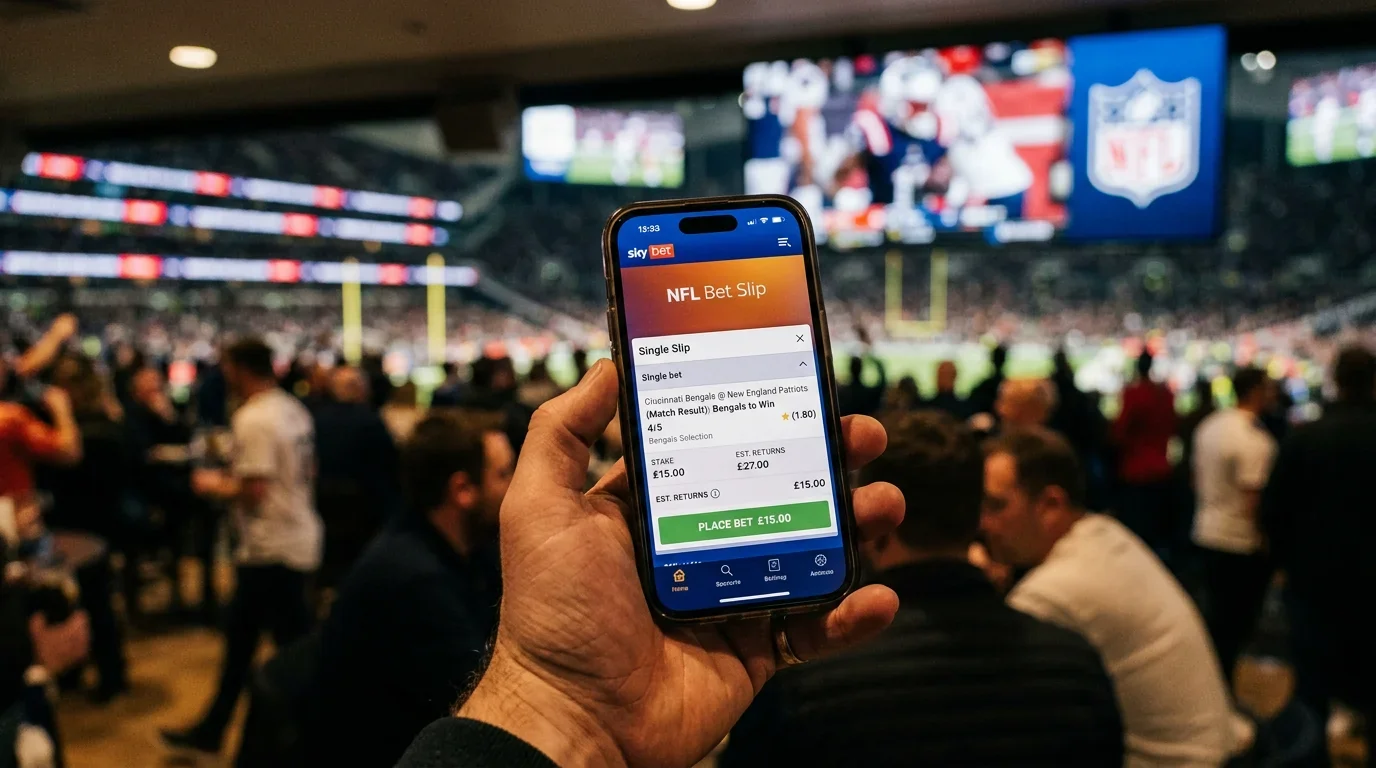
I placed my first NFL bet at a betting shop counter in 2003. I placed my last desktop NFL bet in roughly 2018. Everything since has been on a phone, and I am unremarkable in that regard – the entire UK gambling market has moved with me. Mobile betting now defines how a UK NFL fan engages with the regulated market, from the moment a deposit prompt appears at account opening to the in-play exit on a fourth-quarter cash-out. Understanding how the mobile environment shapes betting behaviour is no longer optional context for serious NFL punters. It is the context.
The Mobile Share Numbers That Set the Backdrop
Mobile devices accounted for roughly 78% of global online betting activity in 2024, and the UK figure is broadly in line with that benchmark. Within specific demographic segments the share is even higher – 76% of UK 18-24 year olds use mobile for gambling, which means for the under-25 cohort mobile is not the dominant channel; it is essentially the only channel.
For NFL specifically the mobile share is higher still, because the audience demographic skews younger than the average UK gambling population. The under-35 share of UK NFL viewers is 33% – double the equivalent US figure of 17% – and that younger audience does virtually all of its betting on mobile. Combine that demographic skew with the late-evening UK kick-off times for NFL fixtures, and the result is a sport where almost every wager placed by a regulated UK bettor is placed through a phone or tablet.
The structural implication is that any analysis of UK NFL betting behaviour is fundamentally an analysis of mobile betting behaviour. The desktop market still exists. It is small enough that I can no longer find it in any of the dashboards I work with. UK online gambling pulls 290 million monthly bets, and 95% of UK online gambling activity originates from home – meaning the phone in your pocket while you are on the sofa watching Sky is the device handling the overwhelming majority of NFL stakes.
The App Features That Actually Affect Your Edge
Most UK NFL bettors use their app’s default settings without ever exploring what the product actually offers. That is a mistake, because two or three configuration choices materially affect betting performance.
The first is odds format. Almost every UK-licensed operator defaults new accounts to fractional odds. Switching to decimal in the settings is the single most useful adjustment a serious NFL bettor will make. The mathematical reasoning is covered in detail in my dedicated piece on converting odds, but the operational point here is that the toggle is buried two or three menus deep and most users never find it. That depth is not accidental.
The second is bet limits and notification settings. Most apps allow you to set per-bet stake limits, daily deposit limits, weekly loss limits and session time alerts. These are positioned as responsible gambling tools – which they are – but they also serve as effective bankroll discipline mechanisms for any bettor who has identified their own tilt patterns. A £50 daily loss limit you set on a Tuesday afternoon is more reliably enforced than a £50 daily loss rule you try to observe at 11pm on a Sunday after three losing bets.
The third is the cash-out toggle and partial cash-out availability. Different operators implement cash-out with different mechanics, and the differences matter for in-play NFL trading. Some apps offer auto-cash-out at user-specified thresholds; others require manual confirmation. Some offer partial cash-out (taking some money off the table while leaving stake exposed); others only offer full cash-out. These mechanical differences shape how aggressively you can run an in-play position before it becomes operationally unmanageable.
One feature that has become standard across UK-licensed operators is the deposit-limit prompt at account opening, mandatory since 31 October 2025. The prompt is a regulatory requirement, but it serves a useful disciplinary function for new bettors who otherwise would not think about deposit limits until they had already lost more than they intended. Setting a meaningful deposit limit at the start of an NFL season is one of the highest-value administrative decisions a UK punter will make all year.
Biometric Login and the Account Takeover Question
The convenience layer of modern UK betting apps – Face ID, Touch ID, fingerprint authentication – has changed how quickly bettors access their accounts. The friction reduction is genuine. The unintended consequence is that the same biometric layer that lets you log in to bet in two seconds is also the layer that protects your account from unauthorised access.
Account takeover (ATO) attacks against UK betting accounts have been a growing concern across the industry, and biometric login is generally a positive defensive layer compared to password-only authentication. The risk is not the biometrics themselves; it is the layered defence around them. An attacker who gains physical access to an unlocked phone with a logged-in betting app can extract value before the legitimate user notices. The countermeasures most users do not configure are screen lock with short timeouts, app-level PIN codes within the betting app, and withdrawal alerts via email or SMS.
A practical configuration that balances convenience and security looks like this: phone-level biometric unlock with a 30-second auto-lock; app-level PIN required for placing any bet over a configurable threshold (£50 is a sensible default); email confirmation required for withdrawals to bank accounts; and withdrawal address pre-registration so that an attacker cannot redirect funds to a new account without an additional verification step. Most UK apps support all four. Most users configure none of them.
Roughly 0.5% of UK adults are classified as problem gamblers under current measurement, and the surrounding regulatory framework places significant emphasis on consumer protection at the account level. Tim Miller of the UKGC has described the regulated market’s underlying principles plainly: the goal is “a competitive and innovative licensed market” that channels bettors away from unregulated alternatives. Account security is part of that competitive offer, even if it rarely makes the marketing materials.
The Mobile Discipline That Separates Profitable Bettors
The convenience of mobile betting is a double-edged blade. The same speed that makes line shopping faster also makes impulse betting faster. The same notifications that alert you to a price move also alert you to a promotion you did not need. The same one-tap stake confirmation that locks in a planned position also locks in a tilt-driven position you would have walked away from if you had to type it into a desktop interface.
The bettors I know who make money on mobile are the bettors who treat mobile as a placement tool rather than as an analytical environment. They build positions on a desktop, in a spreadsheet, with a model. They convert those positions into a list of intended bets. They then use the mobile app purely to place and monitor those bets, with the analytical work already done. The phone never makes a betting decision for them. The phone executes decisions made elsewhere.
Bettors who do the analysis on the phone – comparing prices, reading match previews, watching highlights, deciding stakes – almost universally underperform their own potential. The mobile environment is too distracting and too convenient to support deliberate decision-making. Notifications interrupt. Other apps compete for attention. The temptation to place “just one more” bet is structurally present in a way it is not at a desktop.
This is also why the most useful single discipline I will recommend to any UK NFL bettor is to write down their intended Sunday positions in advance and refuse to place any bet that is not on the list. The phone executes the list. Anything outside the list is by default not a bet. That rule eliminates 80% of the impulse problems mobile betting otherwise creates.
Notifications, Promotions and the Acquisition Architecture
UK betting apps are designed around one commercial objective: maximising lifetime customer value. The tools that serve that objective – push notifications, in-app promotions, free bet offers, boosted prices – are the tools the bettor encounters most frequently. Understanding what each is designed to do helps separate the genuinely useful product features from the marketing layer that exists to extend session time and increase stake volume.
Push notifications are the most aggressive of these tools. The default notification settings on most UK NFL betting apps will alert you to upcoming matches, line moves, in-play opportunities, prop boosts, and “your team is playing” reminders. Almost none of these notifications serves the bettor. All of them serve the operator’s session-time metrics. My recommendation is to disable all marketing-related notifications and keep only the operational ones – withdrawal confirmations, deposit confirmations, account-security alerts. The product is more useful when it is quieter.
Promotional notifications tied to free bets and price boosts deserve a particular note because the underlying offers have changed under recent UK regulation. From 19 January 2026 the ten-times wagering cap and the ban on mixed-product promotions came into force, which means many of the promotions UK NFL bettors will encounter are simpler in structure than the offers that existed two years ago. Free bet offers must now follow stricter wagering rules, and bonus structures that previously cross-promoted casino content alongside NFL betting have been substantially curtailed. The headline effect is positive for bettors. The detail is that the offers you see today are different in shape from the offers you saw in the 2023 season, and assuming continuity between the two leads to mistakes about expected value.
The broader regulatory architecture that produced these changes – including frictionless financial risk assessments and the gambling levy framework – feeds into how the mobile NFL betting environment is structured today. The detailed mechanics of those consumer protections sit within the wider responsible gambling tools framework for UK NFL betting that governs the regulated market.
The Phone Is Now the Stadium
What started as an alternative channel to retail betting shops has become the only channel most UK NFL bettors will ever use. The phone is now the broadcast device, the analytical interface, the bookmaker counter, and the bankroll dashboard, all collapsed into a single piece of glass in your pocket. That convergence is a competitive advantage for bettors who configure the device deliberately and a structural trap for bettors who let the device’s defaults drive their behaviour.
The bettors who treat mobile as a placement tool rather than as a thinking tool are the ones who consistently extract value from the regulated NFL market. Everyone else is a customer of the operator’s product team, and the operator’s product team is paid to make sure those customers spend more this season than they spent last season. There is no scandal in that. It is simply the commercial reality of the platform every UK NFL bettor now uses, and acting in awareness of that reality is the difference between using mobile betting effectively and being used by it.
Are NFL betting apps available equally on iOS and Android in the UK?
Most major UK Gambling Commission-licensed operators publish full-feature apps for both iOS and Android, with broadly equivalent functionality across the two platforms. Some smaller operators or international books may offer a more polished experience on one platform than the other, and a small minority of books still rely on a mobile-optimised browser site rather than a native app. For the majority of UK NFL bettors using the established UK retail brands, platform choice does not materially affect product capability or NFL market access.
Does enabling biometric login increase account takeover risk?
Biometric login generally improves account security relative to password-only authentication because it adds a hardware-bound factor that an attacker cannot replicate remotely. The residual risk is that an attacker with physical access to an unlocked phone can use the logged-in app to place bets or move funds before the legitimate user notices. Mitigations include short device-level auto-lock timers, app-level PINs for high-value actions, withdrawal address pre-registration, and email or SMS confirmation alerts for any withdrawal request. Configuring those layers reduces the residual risk to a level most regulated bettors find acceptable.
Created by the ”nfl Betting Markets” editorial team.