NFL Implied Probability Conversion: Reading Odds Like a Trader
 Available in US
The conversation that prompted me to write this piece happened on a flight back from a Tottenham game last October. The man in the seat next to me was a serious football punter with twenty years of experience. He asked me what 6/4 meant in American odds. He had no idea. He had been betting NFL for two seasons through a UK app that displayed prices in fractional format and had never once stopped to convert them into a probability he could actually compare against his model. Implied probability is the most under-taught concept in UK NFL betting, and the bettors who do not understand it are the bettors who quietly hand the market its margin every weekend.
Fractional Odds: Why the UK Default Slows You Down
Fractional odds are the historic default for UK sports betting and the most analytically inefficient way to read NFL prices. The mechanic is simple – a price of 6/4 means £4 staked returns £6 profit plus the original stake – but the cognitive load required to convert that fraction into a probability is real. For most bettors, fractional odds are a permission structure to skip the conversion step entirely.
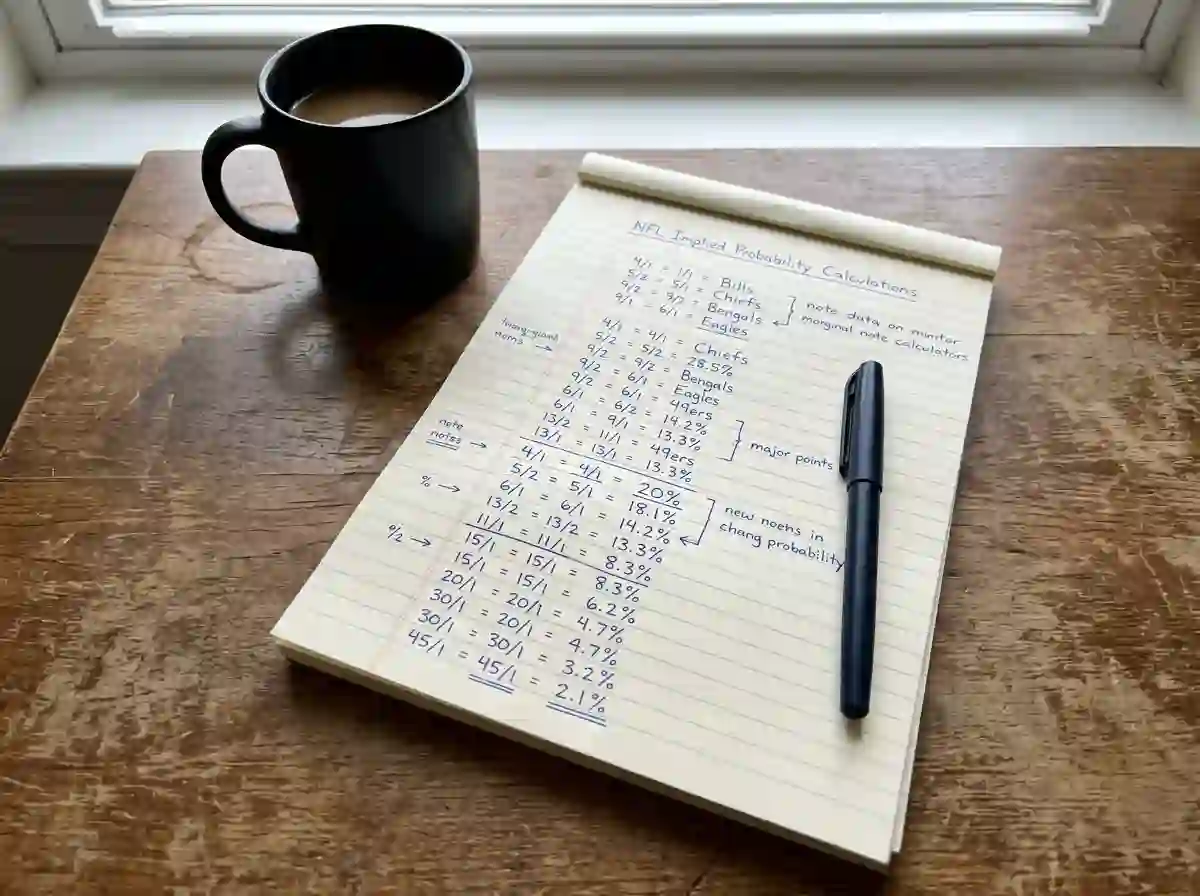
The conversion formula for fractional odds is the denominator divided by the sum of numerator and denominator. A price of 6/4 implies a probability of 4 divided by (6 plus 4), or 40%. A price of 11/10 implies 10 divided by 21, which is roughly 47.6%. A price of 5/2 implies 2 divided by 7, or 28.6%. None of those calculations is hard. All of them are hard enough that bettors stop doing them under time pressure on a Sunday afternoon.
The practical consequence is that bettors trading in fractional formats tend to bet on intuition rather than on probability comparisons. They like the look of 6/4 because the number 6 feels generous. They balk at 11/10 because the number 11 looks awkward. The actual probabilities – 40% versus 47.6% – are seven percentage points apart, and that seven-point gap is the difference between a profitable position and a losing one if your model says the true probability is 44%.
If you are betting NFL in the UK and your default odds display is fractional, my single piece of advice is to switch your betting app to decimal. Every UK-licensed operator offers the toggle. Most bettors leave it on the default. The five seconds it takes to change the setting is the highest-return administrative task you will perform in your betting career.
Decimal Odds: The Conversion That Takes One Second
Decimal odds are the format used across most of Europe and increasingly across professional UK trading desks. A price of 2.50 means £1 staked returns £2.50 in total – including the original stake – so the profit is £1.50. The probability conversion is brutally simple: divide one by the decimal odds and you have the implied probability.
Two-point-five decimal converts to 1 divided by 2.50, which is 0.40 or 40%. One-point-91 converts to 1 divided by 1.91, which is roughly 52.4%. Three-point-00 converts to 1 divided by 3, which is 33.3%. The conversion is fast enough to do in your head while the betting app loads. That speed advantage is exactly why decimal odds are the format used by anyone who trades volume in NFL markets.
The other advantage of decimal odds is that they make line comparison trivial. A 2.10 line at one operator and a 2.20 line at another are immediately comparable as 47.6% versus 45.5% implied probability. The same comparison in fractional odds – 11/10 versus 6/5 – requires two separate conversions before you can determine which is the better price. Line shopping is faster, more accurate and less prone to error in decimal format.
UK remote betting GGY has scaled to roughly £2.6 billion across all sports, with the NFL share of that figure rising as the audience expands. The professional traders who set the prices on these markets work entirely in decimal. The retail bettors who lose money to those traders work largely in fractional. That is not a coincidence. Format choice is one of the small structural advantages the market keeps over the casual bettor, and it is one of the easiest to neutralise.
American Odds: When the UK Bettor Should Care
American odds are the format used across the United States and on most NFL coverage you will encounter from US sources. A bettor who reads US betting analysis – and most serious UK NFL bettors do – needs to be able to convert between American and decimal at speed.
The conversion rules for American odds are straightforward but split into two cases. For positive American odds (e.g. +150), divide the number by 100 and add 1 to get decimal odds. So +150 is 1.50 added to 1, which is 2.50 decimal, which is 40% implied probability. For negative American odds (e.g. -120), divide 100 by the absolute value and add 1. So -120 is 100 divided by 120, which is 0.833, plus 1, which is 1.833 decimal, which is roughly 54.5% implied probability.
The probability shortcut for American odds bypasses decimal entirely. For positive odds, implied probability is 100 divided by (American odds plus 100). +150 becomes 100 divided by 250, which is 40%. For negative odds, implied probability is the absolute value of American odds divided by (absolute value plus 100). -120 becomes 120 divided by 220, which is roughly 54.5%. Same answer, fewer steps.
The reason any UK bettor needs to know American conversions is that the sharpest NFL analysis on the internet is published in American odds, and the line moves that drive those analyses are quoted in the same format. A UK bettor who cannot read the American line cannot read the analysis that explains why the line moved, which means they cannot incorporate the underlying logic into their own model. Format fluency is part of analytical fluency in NFL markets.
Stripping the Vig and Reading the True Probability
The implied probabilities you read off any betting price are not pure probability estimates. They include the operator’s margin, known as the vig, juice, or overround. Stripping the vig is the step that separates the price the bettor sees from the probability the operator’s model genuinely believes.
The mechanics are easier to demonstrate than to explain abstractly. A standard NFL spread market posted at -110 on each side has implied probabilities of 52.4% on each side – total 104.8%. The 4.8% above the natural 100% is the operator’s margin. To strip the vig, divide each side’s implied probability by the total. 52.4% divided by 104.8% gives a vig-free implied probability of exactly 50% for each side. That 50% is the operator’s actual probability estimate. The 52.4% is the price they are charging the bettor to access that estimate.
This matters because your edge calculation depends on the vig-free probability, not the raw implied probability. If your model says the home team has a 54% chance of covering the spread and the price is -110 with a vig-free implied probability of 50%, your edge is 4 percentage points. If you compared your 54% to the raw 52.4% implied probability, you would calculate an edge of only 1.6 percentage points and likely conclude the bet was not worth taking.
NFL plus college football together accounted for roughly 34% of US sports betting handle in 2024, which gives some sense of the scale at which professional NFL traders operate. Those traders set vig-free prices first and then add margin to produce the lines retail bettors see. Reverse-engineering that process to recover the vig-free probability is the analytical step most casual UK bettors skip, and it is the step that determines whether your perceived edge translates into a real edge.
For two-sided markets like NFL spreads, the vig stripping is mathematically clean. For three-way markets, prop markets with multiple outcomes, and futures markets with many participants, the stripping is messier and the operator’s margin is typically wider. Wider markets mean larger overrounds, which means the gap between raw implied probability and true vig-free probability is bigger. That is why prop and futures markets reward analytically rigorous bettors disproportionately compared to mainline sides and totals – and where the broader framework laid out in my UK NFL line shopping piece ties directly into the conversion mechanics covered here.
The Mental Habit That Pays for Itself
Implied probability conversion is not a topic you study once and then forget about. It is a habit you build over hundreds of betting decisions until it becomes automatic. The bettor who can glance at a 2.10 decimal line and immediately know that translates to roughly 47.6% implied probability has an analytical advantage over the bettor who cannot, even before either of them has built a model.
The exercise that builds this fluency is mechanical and slightly tedious. For one weekend of NFL betting, write down the decimal odds and the implied probability for every market you look at, even the ones you do not bet. After three or four hours of conversions you will start doing them in your head. After a full season the conversion is automatic and you can hold a probability comparison in your mind while you are line shopping or evaluating a model output.
None of this is sophisticated mathematics. All of it is the foundational literacy that determines whether the rest of your analytical effort actually produces returns. The bettor who builds a great model and cannot convert odds to probabilities at speed is the bettor whose model never reaches its potential because the trading layer above the model is dropping value at every step. Get the conversions right first. The model has a chance to perform after that.
Why is fractional format slow for serious NFL bettors?
Fractional odds require an additional cognitive step to convert into implied probability – denominator divided by the sum of numerator and denominator. That extra step is small but compounds across hundreds of bets per season. Decimal format converts to probability with a single operation (one divided by the odds) and makes line comparison between operators trivially fast. Most UK-licensed apps allow users to switch the default display from fractional to decimal in their account settings, and serious NFL bettors almost universally choose decimal for that reason.
What overround should a UK bettor expect on a typical NFL spread?
A standard NFL spread market posted at -110 on each side carries an overround of roughly 4.8%, equivalent to a 2.4% vig per side. Wider spread markets, prop markets and futures all carry larger overrounds – sometimes 10% to 20% or more on multi-outcome markets – because the operator’s margin is distributed across more outcomes. Reading these overrounds correctly requires stripping the vig from the raw implied probabilities to recover the operator’s true probability estimate, which is then the figure you compare your own model against.
Published by the nfl Betting Markets team.