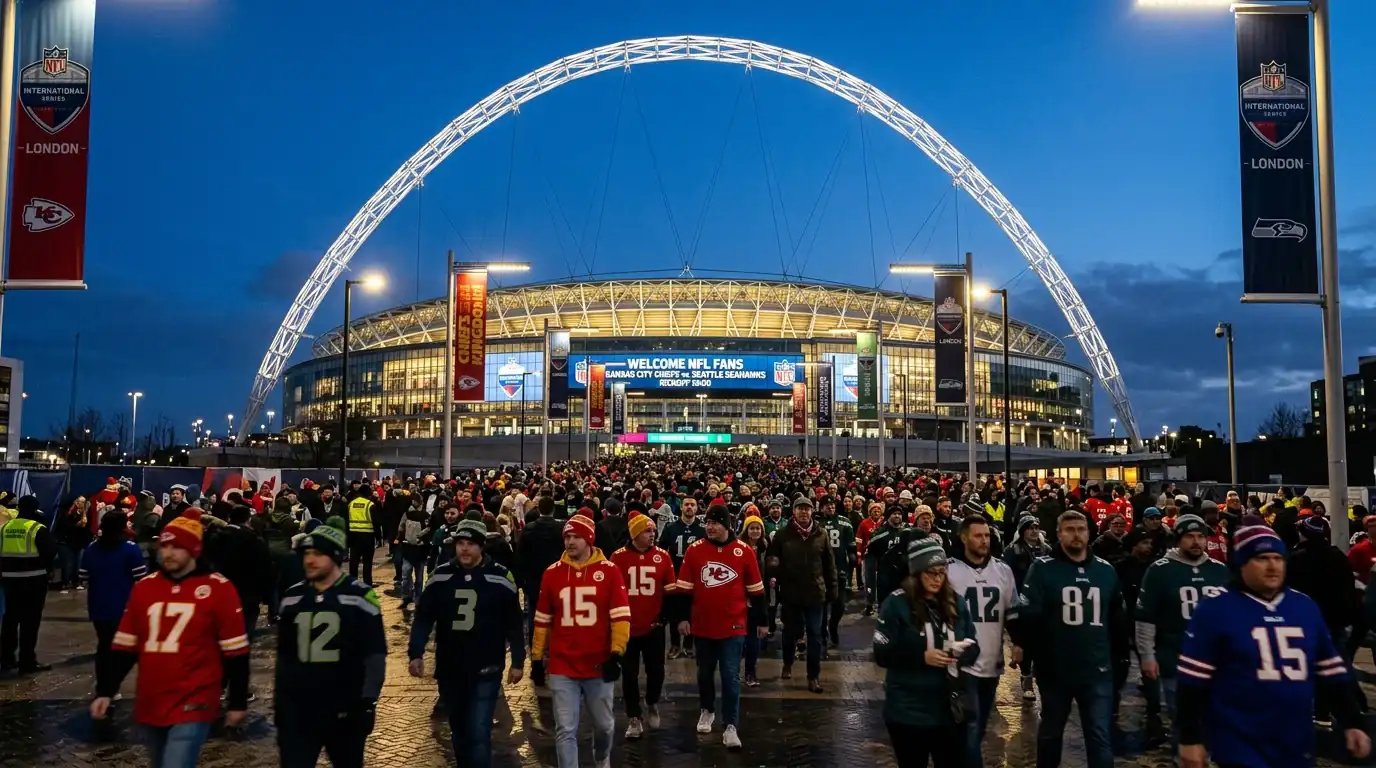
Super Bowl UK Viewership: A Decade of Audience Growth
 Available in US

The first Super Bowl I watched in a UK living room had four people in it. The most recent had fourteen, half of whom asked me what a “two-point conversion” was during the third quarter. That is the British NFL story in microcosm, and the audience numbers behind it are now large enough to reshape the betting market that sits underneath them. I have been tracking the UK Super Bowl audience for seven seasons because the size and shape of that audience determines how the prop markets are priced, how the novelty markets behave, and which operators throw real promotional weight behind Super Bowl Sunday.
The LVIII Headlines That Reset the Conversation
Super Bowl LVIII was the moment UK Super Bowl viewership stopped being a curiosity and started being a meaningful broadcast event. Total UK unique viewers reached 3.4 million, a 48% year-on-year increase, and the peak audience hit 1.73 million at 23:43 GMT. Anyone who has watched a Super Bowl in the UK knows what 23:43 means in practice – it is the moment late-game drama collides with second-half fatigue, and the audience that stays through that window is the audience that genuinely cares.
Sky’s own data tells the same story from a slightly different angle. Sky’s peak Super Bowl LVIII audience landed at 761,000, up 35% year-on-year. Reach hit 935,000, up 63%. The female viewership figure rose 93%, and that is the number that matters most for anyone trying to forecast where this audience goes next. As Brent Hodgson summarised when discussing the period, “Super Bowl LVIII was the most-watched Super Bowl ever in the UK.” That descriptor stops being a marketing line and becomes a structural fact when you align it with what happened underneath the top-line numbers.
Two things are happening simultaneously. The audience is growing in absolute size, and the composition of that audience is shifting toward demographic groups that have historically been under-represented in UK NFL viewing. Both shifts feed into how the betting markets behave on Super Bowl Sunday – more first-time bettors, smaller average stakes, a wider distribution of selections in novelty and prop markets, and a higher overall handle.
The Under-35 Shift That Changed Everything
If you only remember one statistic from Super Bowl LVIII it should be this: under-35 UK viewership was up 91% year-on-year, and 74% of those under-35 UK viewers chose the Super Bowl over other sport that week. Both numbers are extraordinary on their own. Together they tell you that the UK NFL audience is being driven by a generational shift, not by a one-off marketing campaign.
The under-35 figure connects to a broader reality of UK NFL fandom. 33% of UK NFL viewers are under 35, compared with 17% in the US – meaning the UK audience is structurally younger than the American base. That has profound implications for the betting market. Under-35 punters bet differently from older cohorts: smaller stakes, more in-play, more novelty markets, more reliance on mobile-first product. It also means the audience is more responsive to platform-led storytelling – TikTok highlights, YouTube long-form, podcast preview shows – than to traditional Sunday morning newspaper preview pieces.
Forty-seven percent of UK adults gamble in some form, and the sports betting share within that figure is dominated by men. Super Bowl Sunday is one of the few moments in the UK calendar where that imbalance temporarily corrects itself. Female engagement spikes, household co-viewing rises, and the betting flows that hit the market on Super Bowl evening reflect a wider demographic mix than any other NFL fixture of the year.
What the Engagement Numbers Say About the Trajectory
Broadcast viewership tells half the story. The other half is engagement on social and digital platforms, and the NFL’s UK social numbers around Super Bowl LVIII were striking. NFL UK social channels generated 1.7 million engagements over Super Bowl week, up 130% year-on-year, alongside 23.6 million video views, up 7%. The engagement-per-view ratio matters here. Video views growing modestly while engagements grow 130% means the audience that is watching content is responding to it more actively. That is the signature of a maturing fan base, not a passive one.
Active engagement translates to betting behaviour in a measurable way. A user who comments on, shares or saves content is significantly more likely to act on a betting promotion attached to that content than a passive viewer. Operators who paid attention to the Super Bowl LVIII engagement spike adjusted their Super Bowl LIX promotional planning accordingly, and the same logic will drive Super Bowl LX activity ahead of the Channel 5 free-to-air broadcast.
The combination of audience growth, demographic widening and engagement intensity is also why Super Bowl LIX in the United States generated $1.39 billion in legal wagers across 68 million American bettors. UK figures are smaller in absolute terms but follow the same growth curve. The peak UK Super Bowl LIX live broadcast audiences settled in the 124.9 to 125.6 million range globally, with the British share continuing the trend established by the LVIII step-change.
Why ITV’s Absence Did Not Slow the Curve
British viewers occasionally ask me why the UK does not get an ITV-style free-to-air NFL push, and the honest answer is that the audience curve has been growing fast enough without one. The arrival of Channel 5 as a free-to-air partner from the 2025 season changes that calculus. Channel 5’s coverage of Super Bowl LX, three playoff games and selected London and Dublin fixtures broadens the entry point for casual viewers who would never start an NFL relationship behind a Sky paywall.
Free-to-air access does not just add viewers; it changes the type of viewer. The casual entrant is more likely to bet small, more likely to bet on novelty markets, more likely to bet via a sportsbook they already use for football. That has implications for how operators acquire customers around Super Bowl Sunday. The free-to-air audience is the marginal audience – the chunk of viewers who tip the entire UK total from one tier to the next. Channel 5 picking up Super Bowl LX is, in audience terms, the most significant single decision the UK NFL broadcast ecosystem has made in five years.
The complementary Sky NFL coverage now expanded under the 2025 deal means UK viewers have, for the first time, a layered broadcast offering – premium subscription tier through the regular season, free-to-air coverage of the marquee night. That is a structure that mirrors how Premier League football, rugby internationals and the Six Nations are now distributed in the UK, and it is the structure that has historically supported sustained audience growth.
The 2026 Forward View
What does the UK Super Bowl audience look like over the next three years? My base case is continued growth at a slower compounding rate. The 48% year-on-year jump for Super Bowl LVIII reflected a demographic catch-up phase that will not repeat at the same magnitude, but the underlying drivers – younger fan base, increasing female engagement, free-to-air access from 2025 onwards, the Tottenham-anchored London game pipeline – all point in the same direction. A UK Super Bowl audience reaching 5 to 6 million unique viewers across the LX to LXII window is a reasonable upper-bound forecast.
For the betting market, the audience trajectory matters because handle scales with viewership but with non-linear elasticity. Each million additional UK Super Bowl viewers tends to produce a disproportionately large jump in novelty-market handle and a smaller proportional jump in mainline handle. That is why Super Bowl prop and novelty markets in the UK have widened year on year – operators are pricing for an audience that is not only bigger but also more inclined to bet on the unusual angles.
The Audience That Now Sets the Calendar
What started as a niche interest watched by a small subscription audience has become a multi-million-viewer event with a measurable demographic footprint and a betting market that responds visibly to its scale. The 17.3 million UK fans who now follow the NFL – including 3.3 million avid fans – form the base from which the Super Bowl audience is drawn each February. The 3.4 million who watched LVIII represent roughly one in five of that base. The audience for LX and LXI will be drawn from the same pool, expanded by Channel 5’s free-to-air reach.
The lesson I took from charting these numbers across seven seasons is that the UK Super Bowl audience is no longer a leading indicator of where UK NFL betting is heading. It is the trailing indicator. The sport’s audience has already grown. The betting market is now catching up to it, year by year, prop by prop, fixture by fixture.
Why does Channel 5 widening Super Bowl access matter for the UK audience?
Free-to-air coverage removes the subscription barrier that historically capped casual UK Super Bowl viewing. Channel 5’s LX broadcast and selected playoff coverage from 2025 onwards extends reach to households that would not pay for Sky, which adds incremental viewers from outside the dedicated NFL fan base. The marginal viewer added by free-to-air is the viewer most likely to engage with novelty markets, light prop bets and household co-viewing rituals on Super Bowl night.
Why is the under-35 demographic shift important?
The under-35 cohort accounts for 33% of UK NFL viewers, roughly double the equivalent US share, which means UK NFL viewing is structurally younger than the US base. Under-35 viewers bet differently – smaller stakes, more in-play, more mobile-led, more responsive to social-platform storytelling – and that demographic skew shapes how operators price Super Bowl prop markets, design promotional offers and structure their content calendars for the week leading into the fixture.
Prepared by the nfl Betting Markets editorial staff.