Super Bowl MVP Betting: A UK Punter’s Approach to Positional Bias
 Available in US

What the Super Bowl MVP market really rewards
“We are thrilled to see the number of people across the U.K. that watched Super Bowl LVIII on Sky Sports, ITV and NFL Game Pass on DAZN,” Henry Hodgson said after the 2024 broadcast – and that 3.4 million UK audience figure was the moment the British MVP market changed shape. The handle on Super Bowl MVP at UK books has roughly tripled in two seasons, and with it the operator pricing has tightened to the point where the easy edges are gone.
The MVP market is a single-winner outright on which player is voted Most Valuable Player of the Super Bowl by a panel of media members. The mechanics sound simple. The pricing is anything but. Roughly 75 percent of MVP votes since the award’s inception have gone to quarterbacks, which means books default to pricing the two starting quarterbacks at the front of the board with everything else on a long tail. That positional bias is the headline feature of the market – and the reason most casual UK punters lose money on it.
The MVP market does not reward “I think this player will do well.” It rewards “I have a thesis on which player the voting panel will reach for if their team wins.” Those are different questions. A receiver going for 200 yards in a losing effort almost never wins. A quarterback throwing two interceptions in a winning effort sometimes does. The voting bias is structural, not statistical, and it shapes the entire price ladder.
This guide is about reading that bias the way a sharp UK punter reads it. I will walk through why quarterbacks dominate, where the non-QB paths to the trophy actually open up, when the lines move and when they sit, and how to pair an MVP bet with a team outright without doubling your exposure to the same outcome.
Why quarterbacks dominate the historic MVP ledger
Pull the list of every Super Bowl MVP since 1967 and the pattern jumps off the page. Of fifty-eight Super Bowls played, the award has gone to a quarterback over forty times. No other position is close. Running backs sit in the high single digits. Receivers and defensive players each have a handful. The voting panel reaches for the quarterback because the quarterback touches every offensive snap and because narrative gravity is real – the man who throws the winning pass is the man who lifts the trophy in the post-game shot.
Anytime Touchdown Scorer remains the most-staked NFL prop market by handle in UK books, but the MVP outright works on different mechanics. Volume of plays does not buy MVP votes. A running back can rush for 100 yards and three touchdowns in a Super Bowl and watch the trophy go to the quarterback who threw the only touchdown pass of the game. That is not hypothetical – it has happened more than once.
For a UK punter, the practical implication is that pricing the two quarterbacks at the top of the board is rarely a mispricing. The two starters typically combine for 65 to 75 percent of the implied probability across the entire MVP market. If you back a quarterback at MVP, you are essentially saying “this team wins, and the winning quarterback plays a normal-or-better Super Bowl.” Those two conditions cover the median outcome.
The trap is the price. Both starting quarterbacks at favourable Super Bowls trade at decimal odds in the 2.50 to 4.00 range, depending on the matchup. That is not a value bet – it is a near-coin-flip at modest premium. The non-QB paths trade at 15 to 50 and longer, which is where the opportunity sits if you can read which game state opens that door.
Receiver, running back and defensive MVP paths
I once watched a UK punter friend land a Super Bowl MVP at 33 on a wide receiver. He had not modelled it; he had simply asked himself the right question. “If this game is a blowout, which side wins?” he said. “And if that side wins by twenty, who scores the long touchdowns?” The receiver path opens on blowouts. The running back path opens on cold-weather games where the offence leans on the run. The defensive path opens on low-scoring games where a single turnover swings the result.
Receivers win MVP when the winning team blows the game open and the quarterback puts up clean but unremarkable numbers. Picture a 30-10 final with three touchdown passes split between two receivers, one of whom catches eight balls for 130 yards. The voting panel splits the QB ticket, and the receiver with the highlight reel breaks through. This is rare but not vanishingly so. The blowout-receiver scenario tends to trade at 25 to 50 on the lead receivers and 60 to 100 on the secondary options.
Running backs win MVP in a narrower set of games. Cold weather, run-heavy game scripts, and a defining late drive in which the back grinds out the clock. A running back with two short touchdowns and a 130-yard line in a one-score win is the canonical MVP-back profile. The handful of defensive MVPs in Super Bowl history have all involved either a pick-six or multiple sacks plus a forced fumble in a low-scoring win. The ledger is small enough that you can read every example in fifteen minutes.
The pricing tell at UK books is whether the long-list options run six or eight names deep at meaningful prices. A market with eight options at 30 or shorter is an honest market acknowledging that non-QB paths exist. A market with two QBs in single figures and everyone else at 50 or longer is a market betting against that scenario heavily – and that is the market in which a researched receiver or back wager carries real value, because the operator’s price is leaving room for it.
One angle I learned the hard way: the running back position is shrinking in modern offences. Snap shares for elite backs have fallen and pass-catching backs split work more often. A back has to be the unambiguous lead workhorse of his offence to carry a realistic MVP path. If the team uses a committee, the MVP price on any individual back is almost always wrong by virtue of being too short – the volume just is not there.
When MVP lines move and when they sit still
MVP lines do not move the way game spreads move. They have two moments of major repricing in a typical Super Bowl week. The first is conference championship weekend, when the two finalists are confirmed and books reprice the entire board overnight. The second is the day before the game, when betting volume peaks and money flow forces the operator’s hand. Between those two moments, the line tends to sit eerily still, because public action is concentrated on game-day rather than the prop boards in the run-up.
That stability is exploitable. If you have a thesis on a non-QB MVP – a receiver in a likely shootout, a back in a likely run-heavy game – the right time to take the price is the Tuesday or Wednesday before the Super Bowl. By Saturday the prices on long-shot positions tighten, because retail money chases highlight names and the book balances exposure by lowering the longest dogs. Tuesday’s 50 becomes Saturday’s 35 on a healthy receiver in a healthy offence, and the closing-line movement is meaningful information for next year’s market read.
Where the line genuinely moves intra-week is on injury news. A starting receiver with a midweek hamstring designation will see his MVP price drift from 25 to 40 within an hour of the report. A defensive back ruled out adds five to ten points to the price of the receiving corps he was supposed to cover. UK books typically suspend the MVP market briefly during major injury reports and reopen at adjusted prices, so checking the board on Tuesday and Friday afternoon is enough to catch most of the meaningful moves.
One pattern I trust: if a book moves a non-QB price two consecutive days in the same direction without a public news catalyst, it is responding to sharp money. Following that move at a slight disadvantage to the original price is often still better value than waiting for the price to settle, because the move tends to keep going.
Pairing MVP with team outright: a UK staking note
The first time I paired an MVP wager with a team outright, I made a beginner’s error. I backed the favourite team at the outright and the favourite quarterback at MVP, and treated it as a “diversified slip.” It was not diversified at all – the two bets were 90 percent correlated. The QB only wins MVP if the team wins, and the team only wins via the QB’s normal level of play. I had effectively doubled my stake on the same outcome at slightly worse blended odds.
The right way to pair MVP and team outright is to think about the marginal scenario. A team-outright wager pays out on every winning path. An MVP wager on the team’s quarterback pays out only on the most common winning path. So if you already hold the team outright, the additional value of an MVP-on-QB ticket is small. The MVP slot is better spent on a non-QB path that pays out on a different scenario – say a receiver who needs a blowout, or a back who needs cold weather. Now the two tickets cover different futures.
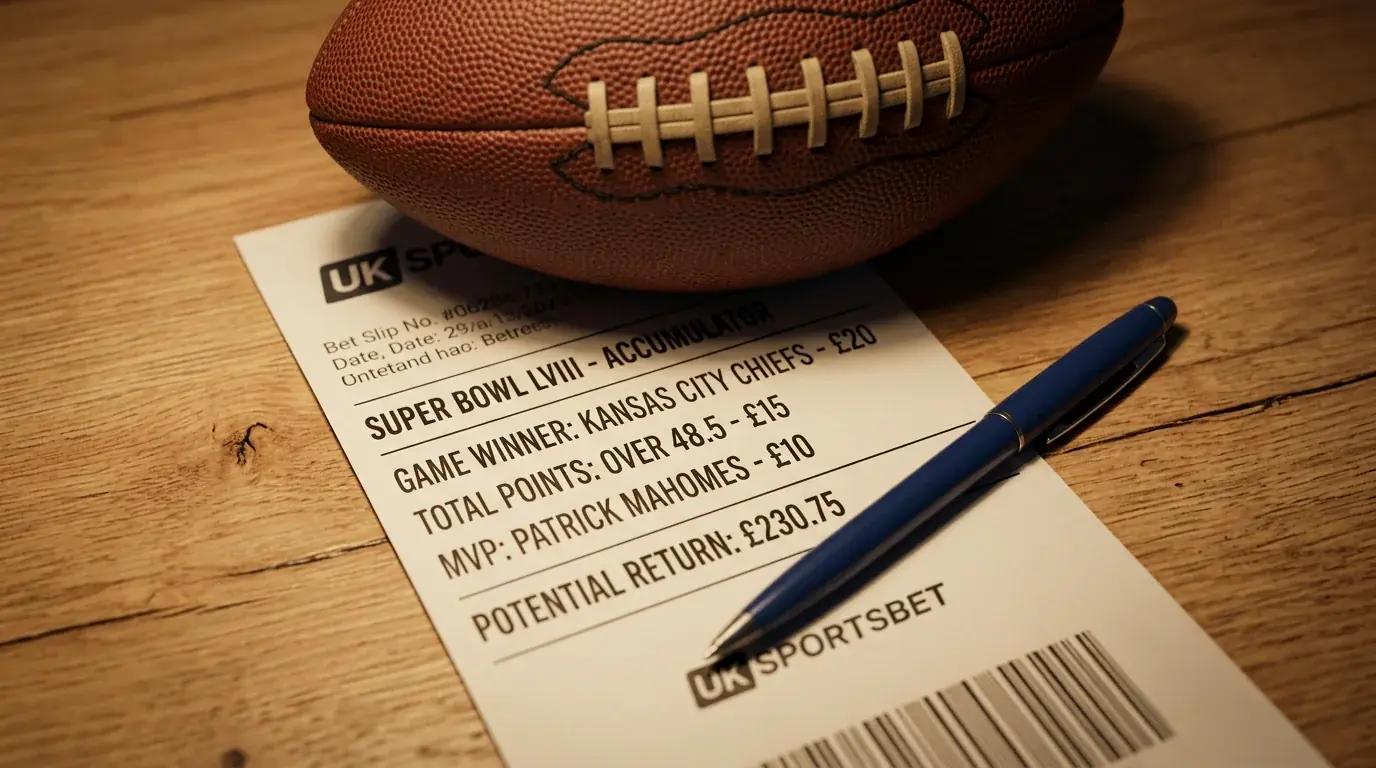
The UK staking implication is straightforward. Treat the team outright and the MVP as two separate edges, and stake them independently to your unit size. Do not size up either because they sit on the same slip. And never combine a team outright with an MVP-on-QB into an accumulator hoping for the headline price – the correlation tax is enormous and books know it. If you want a single-slip parlay angle, the Super Bowl accumulator strategy guide covers correlation rules in detail and should be read before you build any multi-leg Super Bowl ticket.
One last note on UK tax position. Winnings on MVP, like all UK gambling winnings, are not subject to income tax for the punter – the tax sits on the operator side. That means the headline odds are the punter’s actual return, with no withholding on a winning outright. UK punters chasing MVP value do not need to hedge against tax friction; they only need to read the market correctly.
Where this leaves the disciplined UK punter
The Super Bowl MVP market punishes lazy thinking and rewards specific theses. The lazy thinking is “I will back the favourite QB and hope his team wins.” The specific thesis is “I think the game state will look like X, and the player most likely to be voted MVP under state X is Y.” Most UK punters do not get past the first version. The handful who do are the ones with consistent records on this market across multiple Super Bowls.
Build the thesis. Take the price early. Pair the MVP wager with a non-correlated team outright, not a duplicate one. And accept that on most Sundays the quarterback wins the trophy, which means the value bets you place on non-QB paths will lose more often than they win – but when they hit, they hit at prices that justify the patience.
Has a defensive player ever won Super Bowl MVP?
Yes, though rarely. The handful of defensive MVPs in Super Bowl history have all involved either a pick-six, multiple sacks plus a forced fumble, or a single game-changing turnover in a close win. UK books typically price defensive MVP candidates at 40 to 100 even on contender teams, reflecting the long ledger of QB winners.
Are losing-team MVP bets ever placed?
The award has gone to a losing-team player only once in Super Bowl history. UK books still price losing-team options on the board, typically at 200 or longer. The expected value is almost always negative, but it remains a market option for punters with a specific shootout thesis.
Prepared by the nfl Betting Markets editorial staff.